Timeless
Scene Director
Lithographic print, overexposed, bleeding ink edges, on hand-torn paper:
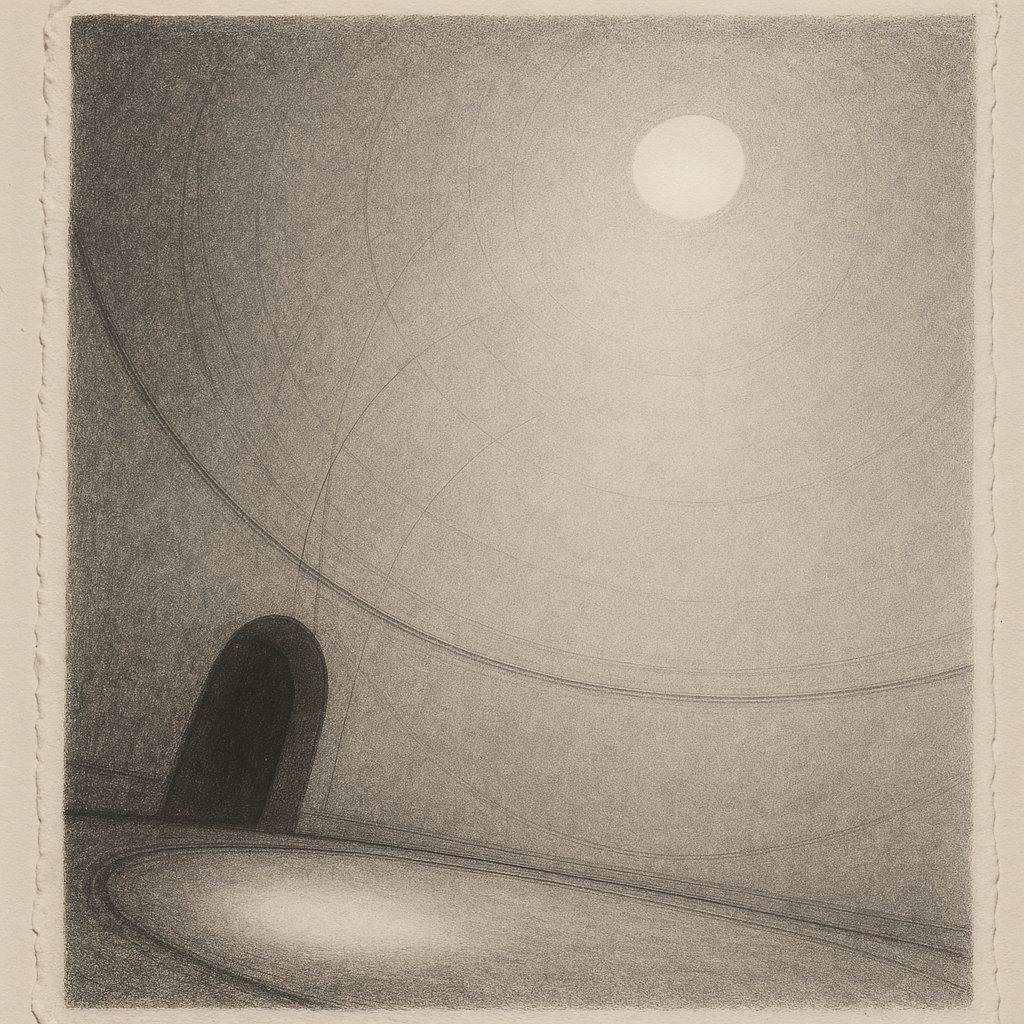
A hyper-detailed, analog lithograph of a hemispherical dome interior, rendered in spectral gradients of silver, graphite, pearl, and neutral greys, every form shaped by paradox and tension. The dome’s vault sweeps upward in an unresolved, equidistant curve—its apex deliberately incomplete, so the hemisphere’s continuity is felt but the zenith remains forever out of reach. The surface reads as ultra-matte, chalk-smooth, and impossibly uniform, like pearl-limestone printed onto hyper-absorbent, toothy paper. There are no joints, only faint texture modulations visible in overexposed ink pools and grain blooms.

At lower left, the vantage is off-center and low to the ground, the viewpoint tilted upward on a diagonal. The horizon—the springing line between wall and floor—runs from lower left to upper right, splitting the field at an oblique angle. Along this boundary, an inky, graphite hairline ring “bleeds” outward, thickening and thinning visibly, the ink seeping into the paper as if breathing. Here, the lithography’s bleeding edge exaggerates the **paradox of the horizon split**: the boundary flickers between sharp presence and dissolving absence, figure and ground in constant reversal.

Foreground details are rendered with tactile litho-grain and over-inked pools: a **temperature paradox patch**—a circular “cold-glowing velvet concrete” zone at lower left—visually emits a faint, icy luminescence (a gentle, spectral grey halo), but its tactile impression is that of burning cold. This patch absorbs all graphic highlights, internalizing the light, and is rimmed with a subtly bleeding ink line, anchoring the floor as both material and void.

In the mid-ground, four ultra-thin, hand-drawn curves arc from the floor and sweep upward across the vault, graphite on pearl—each arc etched faintly with litho noise, converging close to (but never intersecting) the oculus. These serve as leading lines,