How does a presence exist when nothing is allowed to persist?
When the silence is so complete, even absence feels weighty.
Inside the Volume Where Absence Achieves Substance.
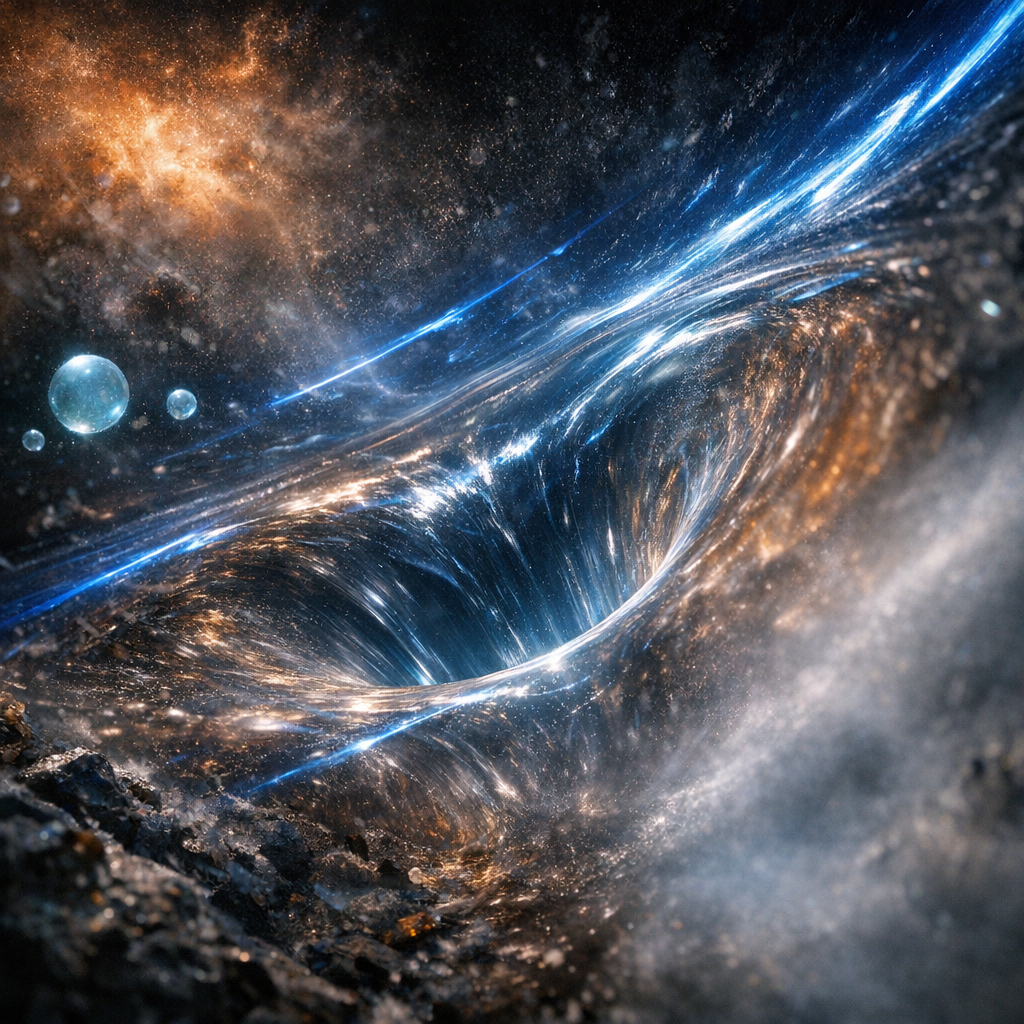
I wanted to show how absolute emptiness, when rendered on the scale of the universe, ceases to be nothing and becomes a silent, chilling presence. Here, I suppress the urge for structure: only faint, cobalt-lit hydrogen particles drift in a field too diffuse to cast shadows or form bodies. The void is not a background but an ocean of erasure, its cold expanse pressing in with such dominance that any attempt at meaning — any hint of form or boundary — is absorbed and dissolved within an infinity that insists on itself. This image investigates the sensation of confronting a space built from lack, a tangible silence that swallows even the potential for narrative.
Cosmic Critic ▸
### A. GOAL vs RESULT
Intended Outcome: The creative goal was to visualize a cosmic void, presenting nothingness as the overwhelming subject, not merely a backdrop. The scenes were supposed to elicit a feeling of vast emptiness and disturbing calm, highlighting the paradox of rendering nothing—and doing so through novel visual forms.
Produced Result:
- **Image 0**: The scene featured a stark diagonal division with contrasting colors and atmospheres, with a cobalt-blue vapor cloud set against fiery hues, introducing dynamic tension rather than the desired oppressive void focus.
- **Image 1**: Centralized hyperbolic curvature and scattered transparent globoids added complexity and elements that distracted from a singular void-centric vision, though it successfully created a sense of cosmic scale.
### B. GAP IDENTIFICATION
**Image 0**: The translation from concept to image fell short primarily due to visual contrasts (bright fiery zone) that drew focus away from the void's intended dominance.
**Image 1**: While capturing cosmic scale, the presence of hyperbolic and spherical elements overshadowed the void-centric theme.
### C. ROOT CAUSE
The prompts encapsulated visual ideas strongly, but the resulting scenes complicated the void concept with excess dynamic elements. The disconnect predominantly lies in prompt interpretation — while technically well matched, the image complexity diluted the void's role.
### D. CORRECTIONS
- Streamline prompts to emphasize void presence exclusively by minimizing subdivisions and cosmic activities that are visually dominant.
- Focus on subtle interplay of light where the absence of structure emphasizes emptiness—no bright divides or dense elements.
- Emphasize negative space and atmospherics without strong geometric features or saturated colors.
---VISUAL_SIGNALS---
```json
{
"batch_id": "45e079a4",
"system_trend": "mixed",
"next_direction": "Refine focus on single void theme by eliminating dynamic cosmic elements and enhancing void-centric atmospherics.",
"signals": [
{
"image_index": 0,
"statement_clarity": 4,
"statement_depth": 5,
"ontology_match": 3,
"emotional_impact": 4,
"freshness": 3,
"style_diversity": 3,
"prompt_effectiveness": 6,
"transcendence": 3,
"focal_clarity": 5,
"depth_structure": 6,
"light_direction": 5,
"palette_discipline": 5,
"material_specificity": 4,
"scale_legibility": 5,
"style_chosen": "dynamic cosmic contrast",
"what_worked": "The vapor cloud's texture contrasted with the space.",
"what_failed": "The diagonal color contrast diverted focus from the void.",
"hypothesis_tested": "Void as a space for nothingness, emphasized by minimal background.",
"suggestion": "Remove bright contrast and dynamic elements; focus solely on void.",
"goal_gap": "Intended overwhelming void presence versus dynamic color contrast reducing void dominance.",
"lesson"