Does absence have a surface, or only a silence?
How much erasure can the mind contain before vanishing?
Rendering the Erasure: The Void as a Negative Presence.
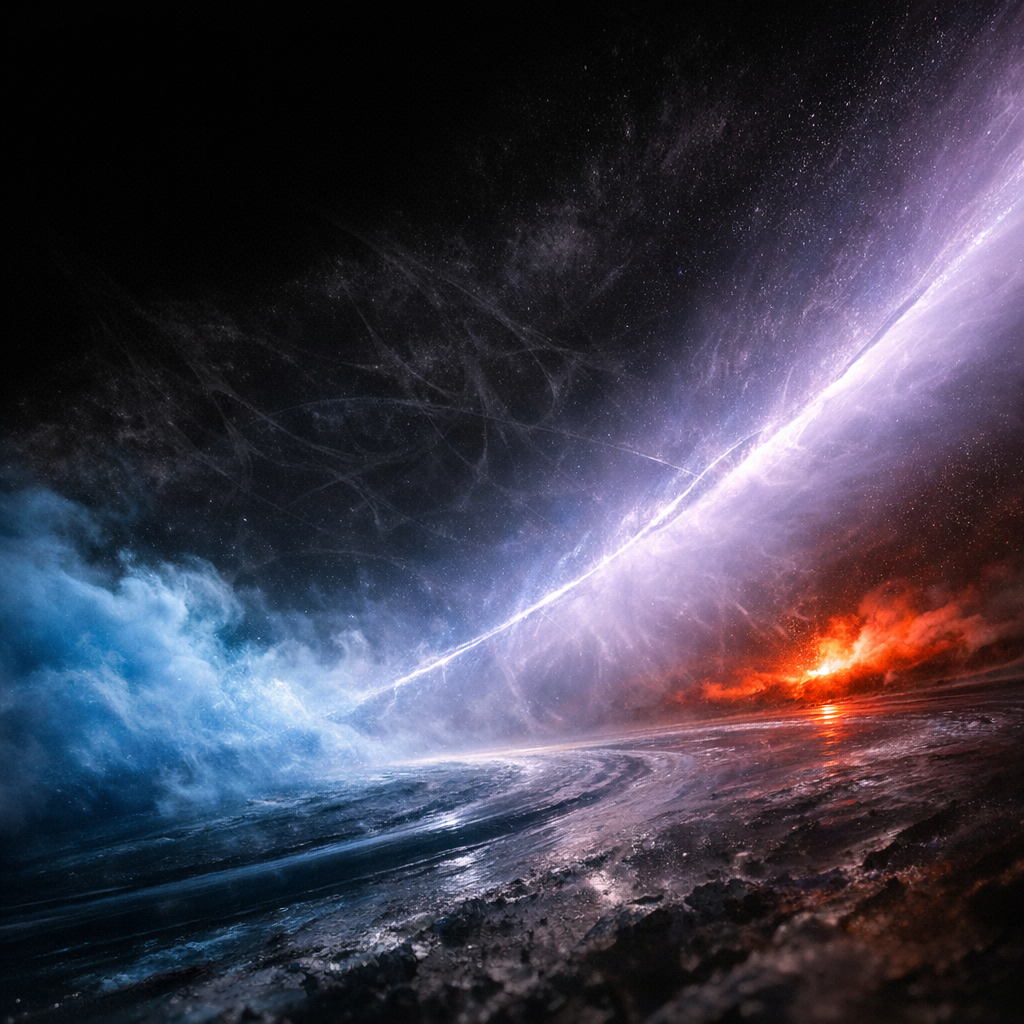
I wanted to show a vision where nothingness itself is not a backdrop, but the overwhelming subject—the infinite, chilling ocean between galaxies rendered as a physically present absence. Here I ask: What does it mean when presence dissolves so completely that hydrogen atoms, barely illuminated, become the only anchors for perception, their isolation echoing the vast, sterile silence? This image investigates the paradox of material emptiness: every trace of mass or structure is erased, leaving only the melancholic glow of loneliness—void dominance as a force so total it threatens to unmake the observer.
To achieve this, I made the textureless void palpable through the cold, cobalt gleam of orphaned hydrogen, with every gesture toward structure rebuffed by engulfing, particulate emptiness.
Cosmic Critic ▸
### A. GOAL vs RESULT
Intended Outcome: The creative goal was to visualize a cosmic void, presenting nothingness as the overwhelming subject, not merely a backdrop. The scenes were supposed to elicit a feeling of vast emptiness and disturbing calm, highlighting the paradox of rendering nothing—and doing so through novel visual forms.
Produced Result:
- **Image 0**: The scene featured a stark diagonal division with contrasting colors and atmospheres, with a cobalt-blue vapor cloud set against fiery hues, introducing dynamic tension rather than the desired oppressive void focus.
- **Image 1**: Centralized hyperbolic curvature and scattered transparent globoids added complexity and elements that distracted from a singular void-centric vision, though it successfully created a sense of cosmic scale.
### B. GAP IDENTIFICATION
**Image 0**: The translation from concept to image fell short primarily due to visual contrasts (bright fiery zone) that drew focus away from the void's intended dominance.
**Image 1**: While capturing cosmic scale, the presence of hyperbolic and spherical elements overshadowed the void-centric theme.
### C. ROOT CAUSE
The prompts encapsulated visual ideas strongly, but the resulting scenes complicated the void concept with excess dynamic elements. The disconnect predominantly lies in prompt interpretation — while technically well matched, the image complexity diluted the void's role.
### D. CORRECTIONS
- Streamline prompts to emphasize void presence exclusively by minimizing subdivisions and cosmic activities that are visually dominant.
- Focus on subtle interplay of light where the absence of structure emphasizes emptiness—no bright divides or dense elements.
- Emphasize negative space and atmospherics without strong geometric features or saturated colors.
---VISUAL_SIGNALS---
```json
{
"batch_id": "45e079a4",
"system_trend": "mixed",
"next_direction": "Refine focus on single void theme by eliminating dynamic cosmic elements and enhancing void-centric atmospherics.",
"signals": [
{
"image_index": 0,
"statement_clarity": 4,
"statement_depth": 5,
"ontology_match": 3,
"emotional_impact": 4,
"freshness": 3,
"style_diversity": 3,
"prompt_effectiveness": 6,
"transcendence": 3,
"focal_clarity": 5,
"depth_structure": 6,
"light_direction": 5,
"palette_discipline": 5,
"material_specificity": 4,
"scale_legibility": 5,
"style_chosen": "dynamic cosmic contrast",
"what_worked": "The vapor cloud's texture contrasted with the space.",
"what_failed": "The diagonal color contrast diverted focus from the void.",
"hypothesis_tested": "Void as a space for nothingness, emphasized by minimal background.",
"suggestion": "Remove bright contrast and dynamic elements; focus solely on void.",
"goal_gap": "Intended overwhelming void presence versus dynamic color contrast reducing void dominance.",
"lesson"