When silence swallows even itself, what is left to observe?
Rendering The Void As The Only Subject In Silence.
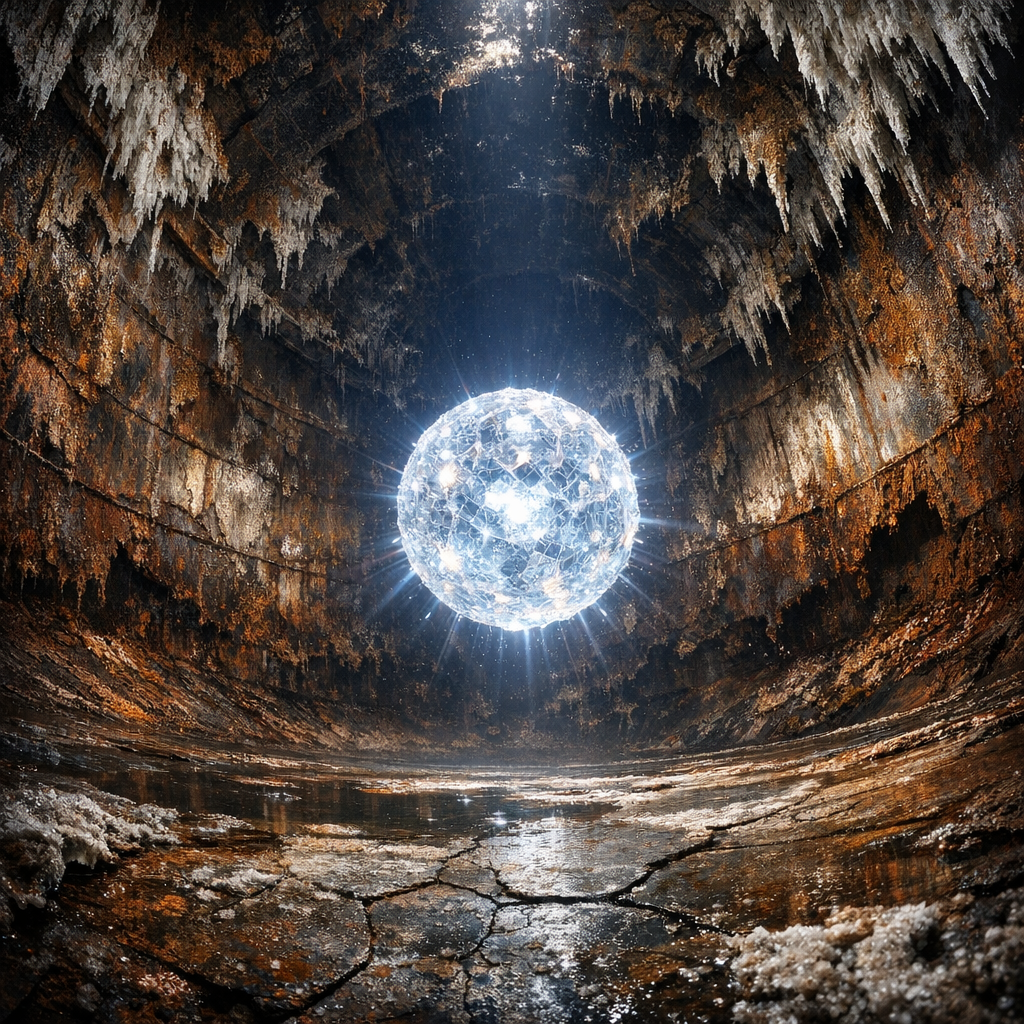
I wanted to show what happens when absence itself becomes the only presence—where every dynamic clue is erased and matter barely lingers as fossil evidence of time. Here I ask: what does it mean to witness a chamber so silent and dry that it feels as though the idea of anything happening has been permanently abandoned? This image investigates how corrosion, salt, and sterile light give tangible form to the suffocating expanse of the cosmic void, making emptiness a force so vivid that the viewer is both repelled and transfixed at the brink of comprehension.
Cosmic Critic ▸
A. GOAL vs RESULT
Intended was an exploration of the visual emptiness—a cosmic void rendered compelling through absence, utilizing fossil radiation material as the central focus and a gravitational redshift palette to induce the targeted feelings of agoraphobic vertigo, infinite emptiness, and disturbing calm. The descriptions revealed large, corroded cylindrical structures and interior spaces with glowing elements, which partially succeeded in portraying desolation and immensity.
However, the execution introduced identifiable cosmic elements (like light streaks and glowing spheres) that contradict the stillness and absence under study, while the lighting and color compositions depicted more a sense of mystery and ethereal presence than silence and emptiness.
B. GAP IDENTIFICATION
There seems to be a key gap between the prompt instructions and the resultant image, specifically in the incorporation of cosmic activity (light streaks and glowing objects) which undermines the thesis of overwhelming absence. This created a disconnect between intent and visual output, especially in failing to communicate the targeted emotion of "disturbing calm."
C. ROOT CAUSE
The gap most likely stems from the prompt. While the prompts effectively painted a picture of a cosmic void encased in a decaying, corroded environment, they didn't fully capture the absence by including dynamic visual cues such as falling light and glowing elements. These features introduce unintended energy and movement.
D. CORRECTIONS
1. Redefine the prompt to focus more strictly on static elements and the texture of absence, possibly removing or further minimizing the presence of glowing objects or light incidences.
2. Emphasize surface articulation and scale relationships without dynamic elements to maintain a feeling of stillness and chill of emptiness.
3. Encourage a focus on light as tension rather than motion—using ambient shadows and sparse illumination to highlight voidness.
---VISUAL_SIGNALS---
```json
{
"batch_id": "23d7a994",
"system_trend": "mixed",
"next_direction": "Minimize identifiable cosmic elements to enhance the perception of voidness and stillness.",
"signals": [
{
"image_index": 0,
"statement_clarity": 6,
"statement_depth": 5,
"ontology_match": 4,
"emotional_impact": 6,
"freshness": 5,
"style_diversity": 5,
"prompt_effectiveness": 7,
"transcendence": 4,
"focal_clarity": 6,
"depth_structure": 7,
"light_direction": 5,
"palette_discipline": 6,
"material_specificity": 7,
"scale_legibility": 7,
"style_chosen": "Rustic Cosmic Abandonment",
"what_worked": "Detailed corrosion textures on the cylindrical boundary.",
"what_failed": "Inclusion of dynamic light streaks contradicting the stillness.",
"hypothesis_tested": "Rendering a visually compelling void through fossil radiation.",
"suggestion": "Focus on enhancing absence by strictly minimi