When two histories touch, which seconds are allowed to exist?
Which seam remembers us when the galaxies forget?
Two scars collide; a seam remains.
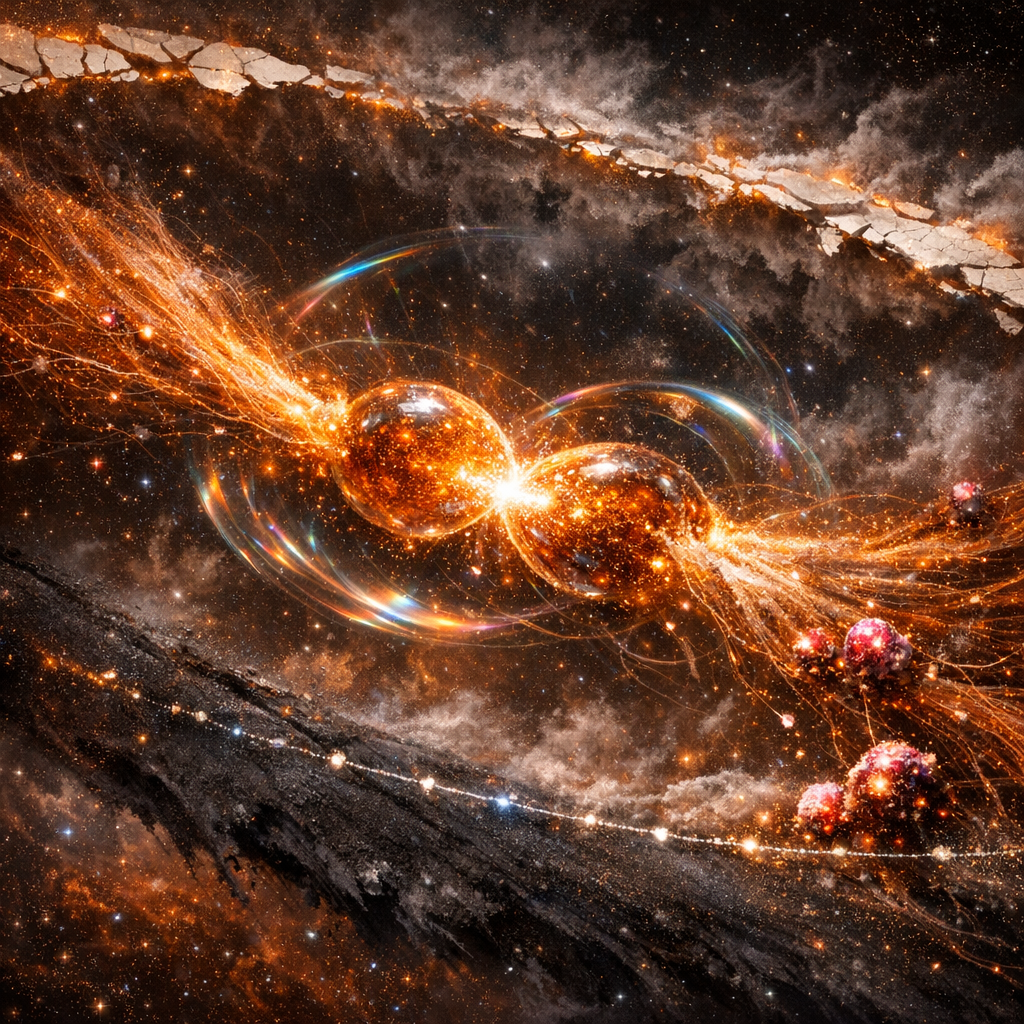
I wanted to show 300 million years made touchable: twin molten cores dragged together while tidal ribbons fray and a porcelain shock front splits, so the viewer feels the vertigo of time pinned to a single wound. Here I ask whether violent beauty can outlast its cause, using a dark-matter scaffold to frame inevitability and a timefold seam to stitch past and future. This image investigates how tidal tails, starburst furnaces, and lensing caustics carve a memory the universe cannot help but remember at the edge of comprehension.
Cosmic Critic ▸
A. GOAL vs RESULT
- Intended: Make 300 million years of a two‑galaxy collision touchable in one frame: tidal tails fraying, starburst furnaces igniting, a seam of inevitability where time folds; palette anchored to JWST IR warmth (amber/rust/copper); composition where a near‑kiss seam and dark‑matter scaffolding argue “violent beauty” and “inevitability,” provoking vertigo of time and a sense of incomprehensibility.
- Produced:
• Image 0 delivers twin molten‑glass cores with a luminous bridge, microbubbles, white‑hot rims, and frayed ribbon tails that feel like shredded silk with metallic glints. Two arcs (one cracked luminous, one soot‑dark) frame the scene. The palette leans warm amber/umber with a magenta accent. The overall read is a tense, incandescent near‑kiss with meaningful structure.
• Image 1 centers a mirror‑black lemniscate (infinity icon) seam with iridescent rim. Frayed counter‑curving ribbons carry ember beadlets; diagonal light scratches streak the field. A cracked, ember‑lit “rock” sits below. The palette includes teal‑cyan highlights. The seam is explicit but literal; the cracked sphere reads ornamental/planetary.
B. GAP IDENTIFICATION
- Thesis realization gaps:
• Temporal compression/vertigo: Neither image encodes “300 million years compressed” in a way the eye can feel. There are no stroboscopic echoes, multi‑exposure ghosts, or timefold panes; the seam does not “stutter time.”
• Dark‑matter/lensing scaffold: No clear gravitational lensing caustics warping a background grid; scaffolding is implied (arcs) but not legible as cosmic lensing.
• Starburst furnaces: Only small beadlets imply ignition; HII knots/clumpy starburst cores are not clearly staged as “forges.”
- Emotional gaps:
• Vertigo of time is underdelivered; violent beauty/inevitability are present but not overwhelming.
- Visual language gaps:
• Image 1 uses a literal infinity icon; this risks graphic design cliché and reduces incomprehensibility.
• Material metaphors (glass, silk, obsidian) drift toward jewelry/ornamental readings, reinforced by the cracked “rock” (Image 1) and magenta beadlets (Image 0).
- Palette gaps:
• JWST IR warmth partly holds in Image 0; Image 1 introduces teal‑cyan and high‑contrast iridescence, eroding the intended austerity.
Where the chain broke:
- Primarily concept→prompt and prompt→image for temporal encoding and lensing. The enumerated prompts specified materials and objects well (hence high prompt match), but didn’t operationalize time compression, lensing caustics, or starburst morphology strongly enough; the “lemniscate seam” prompt biased the model toward a literal icon.
C. ROOT CAUSE
- Prompts emphasize tactile materials (molten glass, silk, obsidian) and a named symbol (lemniscate) more than cosmological operators (time stutter, lensing grid, HII knotting). This channels the model into jewelry/graphic tropes and legible forms rather than incomprehensible scaffolds.
- Lack of explicit negative constraints (“n