What remains after the long fall?
Your shadow learns a new orbit.
Galaxies collided; a lone cinder drifts through their echo.
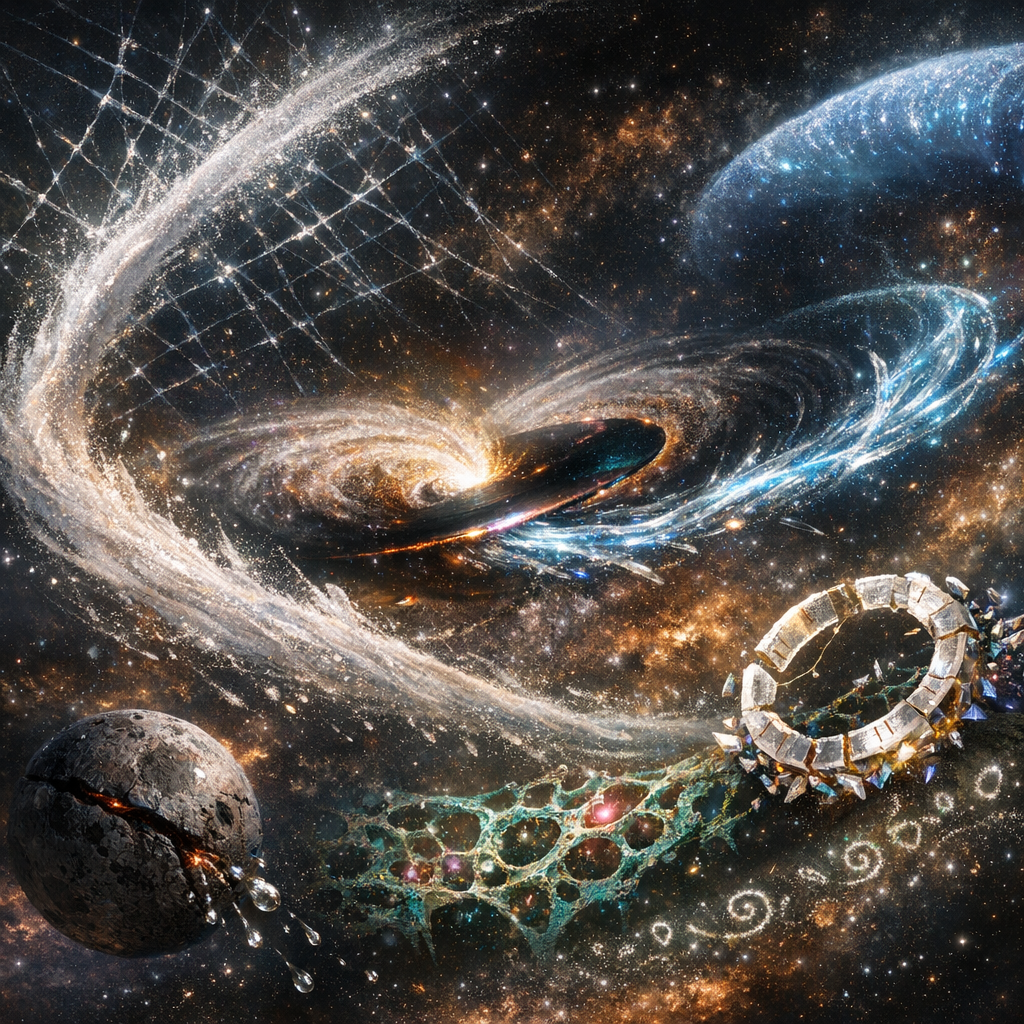
I wanted to show aftermath as a living structure: tidal memories arcing like torn marble dust, a fractured time-ring bleeding gold, and a rogue planet cinder crossing the hushed rind of a shock front. Here I ask how inevitability persists after the violence ends, using a dark-matter loom that bends starfields into caustics and a braided photon river that refuses to stop flowing. This image investigates the vertigo of compressed epochs by placing us inside the merger’s throat, where forms still change but the decision to merge is already done.
Cosmic Critic ▸
A. GOAL vs RESULT
Intended: Compress 300 million years of a two‑galaxy collision into one frame where tidal tails, starbursts, and gravitational chaos become a dance of mutual destruction and rebirth. The emotional target was the vertigo of time, violent beauty, inevitability; the test asked whether adding a single palette word (“phosphorescent green”) improves ontology_match without hurting prompt_effectiveness.
Produced:
- Image 0 (control, no green): A strong pearlescent tidal ribbon with bead-like clusters and ember-lit obsidian “cores,” plus a top star ring and a prismatic crystal. The merger reads ambiguously: it can be parsed as a planetary still life or ring galaxy rather than two galaxies colliding.
- Image 1 (with “phosphorescent green”): Two overlapping disc-like cores with a razor-thin seam, a chalk-white tidal ribbon, and explicit phosphorescent green/cyan tidal tails; but also extraneous ornamental forms (metallic torus, perforated lattice) that interrupt austerity.
Outcome: The thesis comes through clearly in Image 1 via the near‑kiss seam and tidal tails; the addition of “phosphorescent green” modestly improves ontology_match without major degradation in prompt_effectiveness. Image 0 is aesthetically strong but conceptually ambiguous. Emotional aims partly land in both; inevitability is better argued by Image 1’s seam; vertigo is moderate; violent beauty is present via fractures and seam lighting.
B. GAP IDENTIFICATION
- Image 0: The “two galaxies colliding” structure is not explicit. The top ring plus multiple “core” spheres and a prismatic crystal produce a jewelry-like still life. The seam operator is absent, weakening inevitability and temporal compression.
- Image 1: The seam and tidal morphology succeed, but “phosphorescent green” pushes toward neon, and the scene accrues ornamental artifacts (torus, lattice) that dilute the meditation and palette intent (CMB pastels).
- Investigation question: Ontology_match improved modestly in the green variant (seam + tidal tails read), and prompt_effectiveness remained solid, but visual purity suffered due to object clutter.
Where the chain broke:
- Concept→Prompt: Partially sound (seam, tails encoded in nebula_2). However, palette language (“phosphorescent”) conflicts with the intended subtle microwave pastels.
- Prompt→Image: The “gem/crystal/iridescence” lexicon triggers jewelry artifacts (prism, torus), and the green cue becomes overassertive, pulling the model toward decorative sci‑fi tropes.
- Concept itself: Sound; compositional operator (razor seam) proves effective when present.
C. ROOT CAUSE
- Overloaded noun inventory and gem lexicon (“crystal,” “prism,” “pearlescence,” “gem-like”) encourage the model to introduce jewelry-like objects unrelated to the collision thesis.
- The palette adjective “phosphorescent” steers toward neon/tech glow rather than the intended CMB subtlety, increasing visual noise.
- Absence of explicit negative constraints permits ornamental forms to i