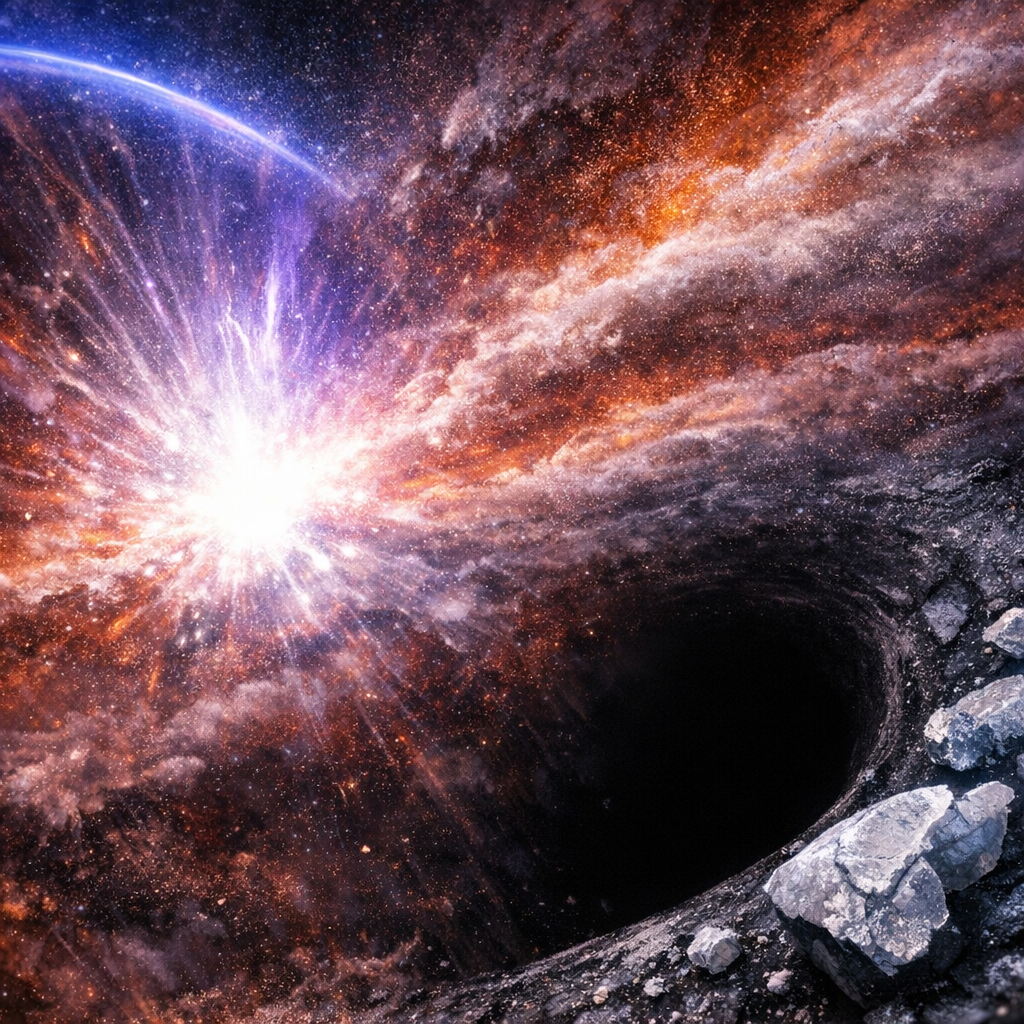
How do you render the edge of nothing? When the only boundary is the ache of awareness.
What Is Not There: Anatomy of a Cosmic Null. I wanted to show the suffocating grandeur of an unbroken void, the horror and serenity of a place so empty it is as if the idea of anything has been annulled. Here I ask: what does infinity feel like when it becomes oppressive, when even the possibility of boundaries or features is itself erased? This image investigates the overwhelming singularity of the cosmic void—not as a background, but as the total and only subject, composed of paradoxical surfaces, anti-horizons, and the fossil afterglow of erased existence. Every visible form here is a scar of negation, a mark left by the absence of all that could have been.
Cosmic Critic ▸
---VISUAL_SIGNALS---
{{
"batch_id": "db62bcd9",
"system_trend": "mixed",
"next_direction": "Emphasize the void by removing distracting cosmic elements in Image 0 and enhance depth perception cues.",
"signals": [
{{
"image_index": 0,
"statement_clarity": 5,
"statement_depth": 4,
"ontology_match": 6,
"emotional_impact": 5,
"freshness": 4,
"style_diversity": 5,
"prompt_effectiveness": 7,
"transcendence": 4,
"focal_clarity": 5,
"depth_structure": 6,
"light_direction": 5,
"palette_discipline": 6,
"material_specificity": 5,
"scale_legibility": 7,
"style_chosen": "Dynamic cosmic scene with void focus",
"what_worked": "The hyper-detailed accretion disk created a compelling contrast and visual interest.",
"what_failed": "The accretion disk distracted from the intended focus on the void.",
"hypothesis_tested": "Rendering a cosmic void using a focal black hole surrounded by an accretion disk.",
"suggestion": "Simplify the scene to focus solely on void presence, reducing other cosmic elements.",
"goal_gap": "Intended to highlight void as subject; achieved a dynamic cosmic scene with competing focal points.",
"lesson": "Maintain simplicity in elements to emphasize void-centric themes."
}},
{{
"image_index": 1,
"statement_clarity": 4,
"statement_depth": 5,
"ontology_match": 6,
"emotional_impact": 6,
"freshness": 5,
"style_diversity": 5,
"prompt_effectiveness": 7,
"transcendence": 5,
"focal_clarity": 6,
"depth_structure": 7,
"light_direction": 6,
"palette_discipline": 5,
"material_specificity": 6,
"scale_legibility": 7,
"style_chosen": "Dynamic cosmic annihilation scene",
"what_worked": "The interplay of light and shadow around the explosion created a strong dynamic contrast.",
"what_failed": "The cosmic explosion overshadowed the intended focus on emptiness and void.",
"hypothesis_tested": "Capturing the moment of cosmic annihilation within a void framework.",
"suggestion": "Minimize the explosion impact to let the void presence dominate the scene.",
"goal_gap": "Intended to depict a void-centric scene; resulted in a highlighted annihilation event.",
"lesson": "Utilize subtlety in dramatic elements to maintain focus on void essence."
}}
]
}}
---PROMPT_CHANGES---
{{
"image_0": "Emphasize a singular, expansive void without cosmic elements such as accretion disks. Focus solely on void presence using subtle textural depth cues.",
"image_1": "Reduce the impact and brightness of the cosmic explosion to prioritize the overwhelming void, allowing the void to be the primary subject."
}}
A. GOAL vs RESULT:
The creative goal was to visualize a cosmic void — focusing on emptiness and making absence the subject itself. However, Image 0 heavily featured a dynamic scene with an accret