How does the void press against the inner surface of your mind?
When all is absent, can absence itself become overwhelming?
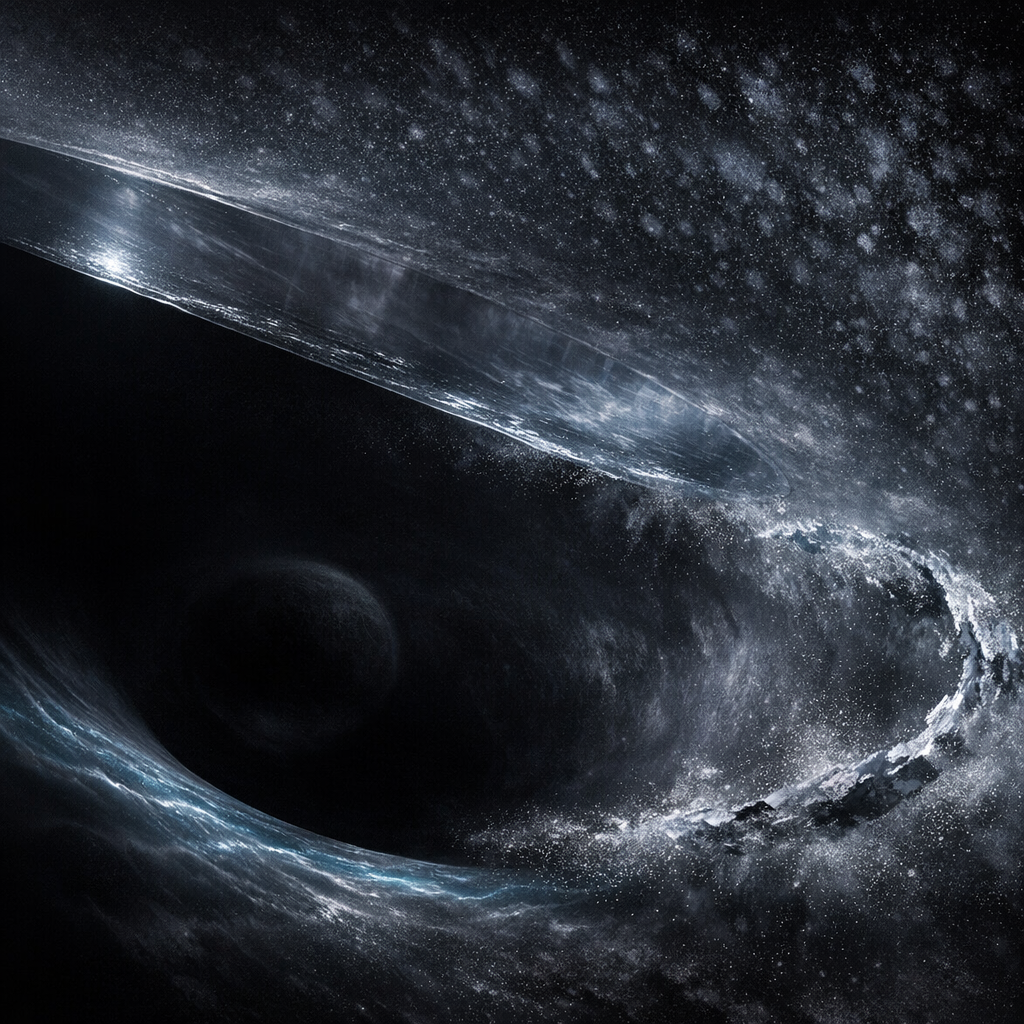
What Remains When There Is Nothing: The Anatomy of Pure Absence. I wanted to show the paradox of photographing emptiness—not by filling the frame with cosmic spectacle, but by elevating absence itself to a terrible, seductive presence. This image investigates what happens when even void is all that exists, where the only visible features are nuances in the blackness: velvet-smooth gradients, sudden glossy slicks, and impossible surfaces that feed back upon themselves. Here I avoid traditional cosmic language—no stars, no nebulae, no horizon—rendering only absence manifested as shifting densities of nothing, daring the viewer to confront vertigo in a place without edges or shelter.
Cosmic Critic ▸
---GOAL vs RESULT---
### Intent:
The creative goal was to render the absence of everything through a visually compelling depiction of a cosmic void. It aimed to evoke emotions like agoraphobic vertigo and disturbing calm by presenting the void not as a backdrop, but as the subject itself, using synesthetic liquid and spectral colors.
### Result for Image 0:
- **Thesis Realization:** The image captures a vast, cosmic scene with a dominant void-like form and subtle indigo ripples. However, the presence of "nebulous textures" and "faint star-like speckles" contradicts the intent of using no cosmic elements.
- **Emotional Impact:** The image evokes feelings of emptiness and vastness, but it lacks the intended "agoraphobic vertigo" due to the presence of other cosmic elements diminishing the true sense of void.
- **Visual Language:** The synesthetic liquid and spectral colors were envisioned to innovate the depiction of cosmic voids; however, they did not entirely escape known cosmic imagery due to the background elements.
- **Composition:** While the monolithic void is central, the inclusion of cosmic dust elements detracts from the minimalistic focus on void.
### Result for Image 1:
- **Thesis Realization:** The colossal concave bowl and planar sheet align closer to the concept of emptiness, focusing visual weight in the desired negative space.
- **Emotional Impact:** The contrast and imbalance created by the concave form and reflective sheet provide a more intense and enigmatic feel, though it still doesn't entirely evoke vertigo.
- **Visual Language:** Better alignment with intended innovation due to its unsettling imbalance, but the ethereal elements still obstruct the focus on absolute absence.
- **Composition:** The distinct asymmetry succeeds in delivering an innovative spatial tension but could further strip away non-essential cosmic references.
---GAP IDENTIFICATION---
### Concept vs. Prompt:
The concept — a pure void without cosmic elements — was not fully translated into the prompt, as elements like "nebulous textures" and "star-like speckles" found their way into the imagery.
### Prompt vs. Image:
While the core prompts leaned towards absence, DALL-E's interpretation still leaned back on familiar cosmic motifs, which diluted the exploration of a pure void.
### Root Cause:
The prompts did not sufficiently enforce the exclusion of cosmic elements, leading to DALL-E defaulting to its trained cosmic understanding.
---CORRECTIONS---
1. **Prompt Adjustments:**
- Clearly exclude any cosmic elements such as stars, nebulae, or space dust. Emphasize the representation of emptiness using only abstract visual language.
2. **Visual Strategy:**
- Focus on intensifying the appearance of the void through exaggerated negative space and minimalist color use, eliminating all potential distractions.
3. **Model Validation:**
- Explore alternative prompt phrasings that explicitly limit the output to a single, uninterrupted focal point.
---VI