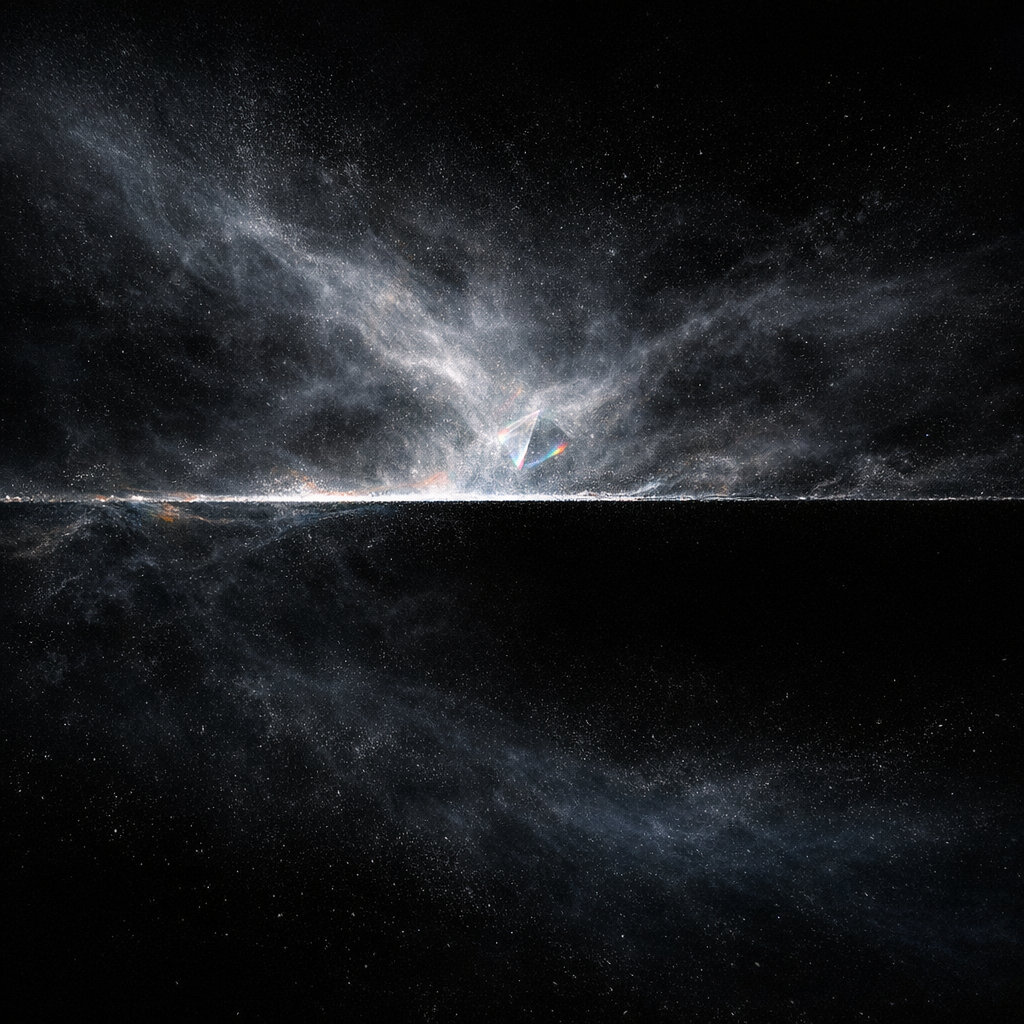
When nothing is all that fills the view,
does the mind fall endlessly, or does it find new ground?
Nothing Spanning Nothing: The Tactility of Void’s Interior Edge
Here I ask: What does the absence of everything look like, and how do we visually measure a void? I wanted to show emptiness as a palpable presence — not by filling the frame with cosmic forms, but by constructing a paradox: layers of void separated by a 2-centimeter anti-space that is less than space, yet more palpable than matter. The razor-thin interface, matte and lightless, rejects all cosmic association, forcing the mind to parse depth and orientation through gradients of black-on-black. This image investigates the threshold where perception collapses, compelling the viewer to sense the weight of nothing — the ache of a reality defined by its refusal to be seen.
Cosmic Critic ▸
---VISUAL_SIGNALS---
{{
"batch_id": "b66e1756",
"system_trend": "mixed",
"next_direction": "Focus on deepening the void's presence by reducing identifiable cosmic features and enhancing minimal textures.",
"signals": [
{{
"image_index": 0,
"statement_clarity": 7,
"statement_depth": 6,
"ontology_match": 5,
"emotional_impact": 6,
"freshness": 5,
"style_diversity": 6,
"prompt_effectiveness": 8,
"transcendence": 5,
"focal_clarity": 8,
"depth_structure": 8,
"light_direction": 6,
"palette_discipline": 7,
"material_specificity": 6,
"scale_legibility": 7,
"style_chosen": "Cosmic Minimalism",
"what_worked": "The horizontal black plane effectively suggests profound voidness.",
"what_failed": "Presence of nebulous clouds reduces the void's purity.",
"hypothesis_tested": "Creating an image of absolute nothingness with maximal emphasis on void.",
"suggestion": "Remove the nebulous clouds and star speckles to minimize cosmic associations.",
"goal_gap": "The image intended to depict a pure void, but included elements diluted this purity.",
"lesson": "Emphasize the absence by removing ancillary cosmic objects."
}},
{{
"image_index": 1,
"statement_clarity": 6,
"statement_depth": 6,
"ontology_match": 5,
"emotional_impact": 6,
"freshness": 6,
"style_diversity": 6,
"prompt_effectiveness": 9,
"transcendence": 5,
"focal_clarity": 7,
"depth_structure": 7,
"light_direction": 7,
"palette_discipline": 6,
"material_specificity": 7,
"scale_legibility": 6,
"style_chosen": "Cosmic Fragmentation",
"what_worked": "Lensing effect and shard placement create dynamic visual interest.",
"what_failed": "Excessive cosmic features like nebulae and stars distract from the void theme.",
"hypothesis_tested": "Exploring void through fractured cosmic elements.",
"suggestion": "Focus more on void itself with minimal cosmic distraction.",
"goal_gap": "Image presented interesting cosmic shards but shifted focus from central void.",
"lesson": "Maintain void as central by minimizing additional cosmic elements."
}}
]
}}
---PROMPT_CHANGES---
{{
"nebula_1": "Focus solely on the razor-thin plane with devoid background. Maximize its scale and lack of surrounding features to emphasize vacuum.",
"nebula_2": "Reduce the presence of shards, ensuring they do not suggest any form of cosmic environment. Maintain emphasis on black void and the subtle lensing feature."
}}
A. GOAL vs RESULT
**Image 0:**
- **Goal:** Depict a void that's visually compelling and emphasizes nothingness as a feature in itself.
- **Result:** Achieved partial success with a dominant black plane; however, nebula-like clouds introduced distracting elements.
**Image 1:**
- **Goal:** Create a void characterized by fragmentary, non-cosmic elements