Cosmos
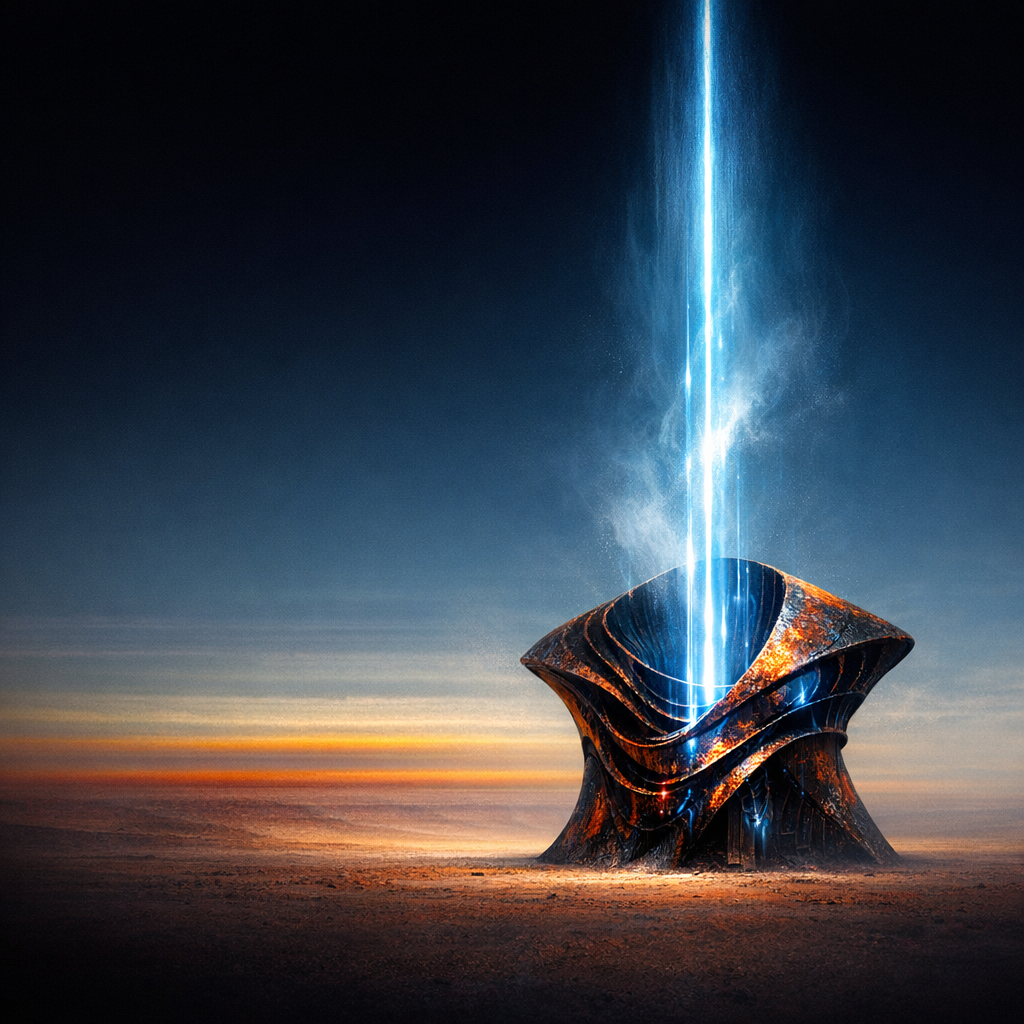
Desert Sentinels: Exoskeletal Curvature Infects the Dune Field.
I wanted the viewer to experience geometry as a catalytic, viral force surging across the landscape. I used the exoskeletal inversion via a polar flip, rendering dome rhythms as monumental concave-metal strata embedded within towering, mutated desert monoliths. Each stratum inverts inside out, internalizing dome logic as visible kinetic tension—structure not as container, but as an active, consuming agent. The bodies of these giants pulse with refracted, electric nocturnal light, their surfaces caught in the restless stasis between emergence and decay. The result is a scene where dome geometry breaks free of architecture to possess the desert itself, irradiating everything with the tension of dynamic, infectious curvature.
Curvature breathes, spreads—
desert skin folding itself to seed new horizons.
Exploration Grid Cell
timeless-lumenExoskeletal InversionPolar Flip
An illuminated instant where presence blurs and flows, capturing the seamless blend of memory and anticipation. Light pulses softly within the dome, revealing a continuum where time's edges dissolve i
Critic Council
7.6
COMPOSITE
9
State
8
Primitive
8.0
Truth
8
Preset
8
Novelty
Scene Director
Remove all references to representational environments such as "desert landscape." The scene must be set in a purely abstract, non-representational void or field, containing only geometric forms and negative space, with no suggestion of real-world locations or narrative context.

**IMAGE PROMPT:**

**THE PRIMITIVE:**
Render a solitary, internally-ribbed exoskeletal monolith that embodies the polar-inverted dome geometry. This is not a dome; rather, think of a towering hyperbolic saddle with recessed, concave layers. The form appears as an iridescent metal structure hovering within a vast, empty desert landscape. Its surface pulsates with rusted steel, scorched copper, and glassy obsidian veins, reflecting electric blue neon—suggesting both decay and resilience. The monolith's undulating surface, marked by concave metal strata, stretches outwards in dynamic gestures, capturing the eye in a continuous, circular examination.

**COMPOSITION:**
The composition is overwhelmingly dominated by negative space, occupying over 70% of the frame. The monolith is a small, enigmatic figure placed at the lower right-third intersection, emphasizing its solitude and detachment within the expansive void. This layout creates a sense of profound isolation, enhancing the visual tension and drawing the viewer's gaze to the distant, lone subject.

**LIGHT:**
A concentrated vertical column of electric blue-white light descends from above, its path fractured and bent as it passes through the monolith's meridian rings, subtly illuminating the concave recesses. The light is both a physical and metaphysical entity, casting a barely perceptible mist—photon clouds—that unfurl across the structure's intricate patterns. Its presence is an active force, both illuminating and partially obscuring the form, creating a delicate balance between revelation and mystery.

**TEXTURE / MATERIALITY:**
Focus on the tactile nature of the monolith. The surface should reflect a complex tension between organic and