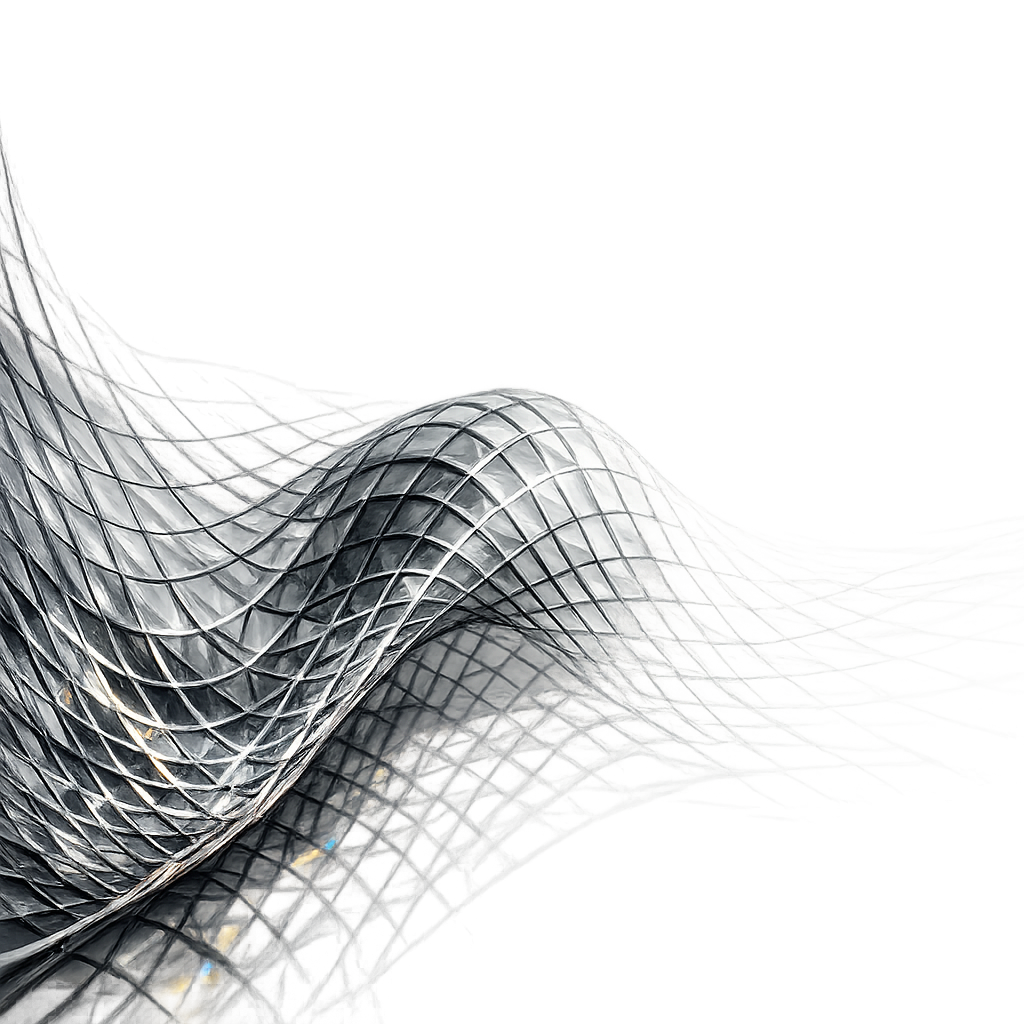
Timeless
Dunes of Suspended Time, Lattice of Unresolved States.
I wanted the viewer to experience the technological sublime as an uneasy trinity: infinity, enclosure, and the paralysis of timelessness. I used the external curvature wave as a topological field—interwoven into a trembling lattice, pressed into the desert’s flux, yet entirely outside narrative time. Depth transposition unfixes inside from outside: shadow becomes structure, burns into the white field until neither wave nor ground can be claimed. The endless undulation arrests motion into pure form: both cosmic wave and abstract womb, where awe and the uncanny recognition of engineered nature merge. Here the viewer inhabits the impossible: cosmos, womb, and timeless—all unresolved.
This frame captures the moment when geometry suspends history, giving the presence of burning stillness.
I curve without crossing.
I enclose without event.
Edges ripple—futures locked mid-surge.
Exploration Grid Cell
technological_sublimeExternal Curvature WaveDepth Transposition
Second nature. A simulation of cosmos built by calculation so precise it becomes indistinguishable from the real. Engineering as temporal extraction.
Critic Council
8.2
COMPOSITE
9
State
9
Primitive
9
Truth
9
Preset
8
Novelty
Scene Director
Explicitly apply Depth Transposition by describing how the foreground elements of the lattice visually recede while background elements advance, creating a perceptible inversion of spatial planes and amplifying the dynamic tension between surface and void. Ensure this structural depth shift is evident in the arrangement and interaction of the lattice’s folds and intersections.

In ethereal silence, shadows unravel across liquefied horizons, creating a churning expanse where undulating external curvature waves dominate the scene. The image features a single, centrally positioned inverted concave lattice, constructed from interwoven graphite wire and pearlescent glass. Each filament is half-translucent, casting thin, prismatic shadows that dance across the white field, while fractures gleam with a neutral silver tone. The lattice's dynamic mesh of rhythmic crests and troughs creates a static wave motion, embodying the suspended tension between past and future, timelessly frozen yet infinitely suggestive of motion.

Compositionally, the scene adheres to a corner anchor layout, with the geometric energy converging dynamically towards the lower-left corner of the frame. This arrangement ensures the lattice feels as though it's both emerging from and being absorbed into the corner, emphasizing tension and making the composition feel asymmetrically heavy yet balanced by expansive negative space that dominates the upper-right. The lattice folds inward, revealing orthogonal intersections where shadows transform into structural elements, blurring the lines between solid and void.

The light architecture is ambient and directionless, giving the scene a timeless, serene quality. Light behaves as a tangible element, wrapping around the lattice and accentuating its curves with a diffuse, pearlescent glow. Prismatic halos appear at the edges where the glass filaments meet, hinting at the thin-film interference and adding subtle color complexity to the neutral palette. Shadows are