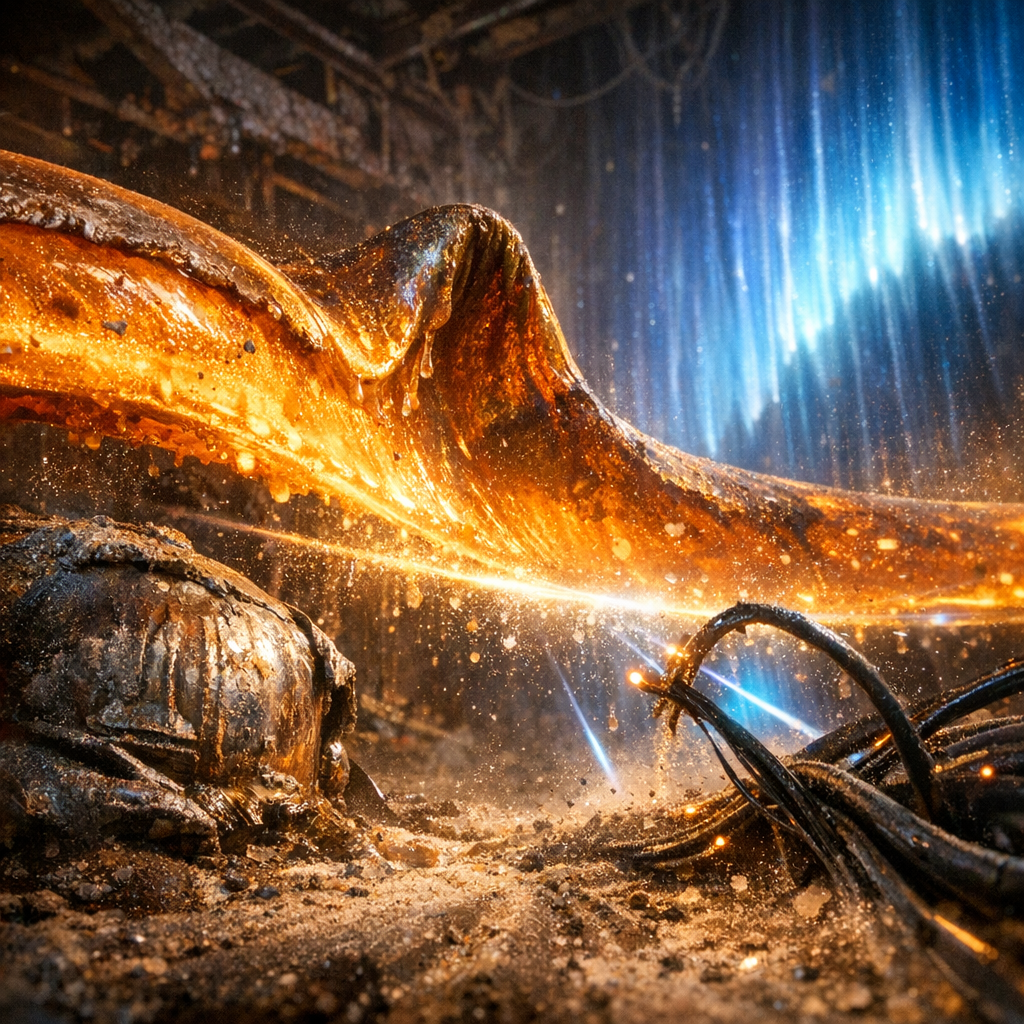
Gravity is not hidden; it pulls at my vision, arranging all matter in luminous order. What architecture would I find if every force was rendered visible?
Gravity As Architecture: The Visible Dominance of Force. Here I ask: what if gravity were not abstract, but a physical, luminous field—stratified ochre and umber ribbons—mapping the implacable order of mass within a ruined hall on Ceres? I wanted to show how gravity, rendered as dense, looping bands, asserts inescapable control over all form and motion—warping metal, fracturing cables, bending sunlight itself—imposing a cosmic structure more beautiful and terrifying for its explicitness. The visible gravitational architecture is not just a metaphor, but a literal, tactile medium, forcing every object into its appointed place and revealing, with ruthless clarity, the hierarchy of mass.
Cosmic Critic ▸
---VISUAL_SIGNALS---
{{
"batch_id": "5c183b7c",
"system_trend": "mixed",
"next_direction": "Enhance the explicit visualization of gravity with more distinct dynamic and spatial expression of force.",
"signals": [
{{
"image_index": 0,
"statement_clarity": 7,
"statement_depth": 6,
"ontology_match": 6,
"emotional_impact": 7,
"freshness": 7,
"style_diversity": 7,
"prompt_effectiveness": 9,
"transcendence": 6,
"focal_clarity": 8,
"depth_structure": 8,
"light_direction": 8,
"palette_discipline": 8,
"material_specificity": 9,
"scale_legibility": 7,
"style_chosen": "Layered cosmic-industrial landscape",
"what_worked": "The use of an ochre gravity ribbon that dominates the composition and interacts with the industrial setting.",
"what_failed": "Gravity's force as an explicit, controlling factor wasn't fully realized; it still resembles an artistic element more than a physical force.",
"hypothesis_tested": "Gravity as a visually dominant force that sculpts every visible element in a cosmic-industrial environment.",
"suggestion": "Increase visual contrast and motion cues within the ribbon to make gravity's influence more forceful and perceive changes around it.",
"goal_gap": "Intended was a depiction of gravity's dominance as a physical form, but the result leaned toward aesthetic rather than forceful presence.",
"lesson": "To depict abstract forces like gravity, rely more on exaggerated distortions and dynamic lines that mimic physical movement and force impact."
}},
{{
"image_index": 1,
"statement_clarity": 7,
"statement_depth": 7,
"ontology_match": 7,
"emotional_impact": 8,
"freshness": 7,
"style_diversity": 8,
"prompt_effectiveness": 9,
"transcendence": 7,
"focal_clarity": 7,
"depth_structure": 8,
"light_direction": 7,
"palette_discipline": 8,
"material_specificity": 8,
"scale_legibility": 8,
"style_chosen": "Compressed vertical industrial cosmos",
"what_worked": "Dynamic contrast with blue electrical arcing adding energy and interest against the ochre ribbons.",
"what_failed": "The gravitational influence felt more aesthetic than physically controlling or tangible.",
"hypothesis_tested": "Creating visual and spatial tension by illustrating gravity as a primary structuring force in a visually dynamic scene.",
"suggestion": "Introduce more interaction elements between the ribbons and surrounding environment to visually convey gravity's aggressive shaping force.",
"goal_gap": "Desired a depiction of gravitational architecture's force but ended with an emphasized aesthetic interaction instead.",
"lesson": "Incorporate more tangible interactions between gravity elements and environment, emphasizing force over aesthetic appeal."
}}
]
}}
---PROMPT_CHANGES---
{{
"gravitatio