How long can you look into endless sameness
before your mind insists it is seeing something there?
Rendering Void as Overwhelming Presence: The Mirage of Absence.
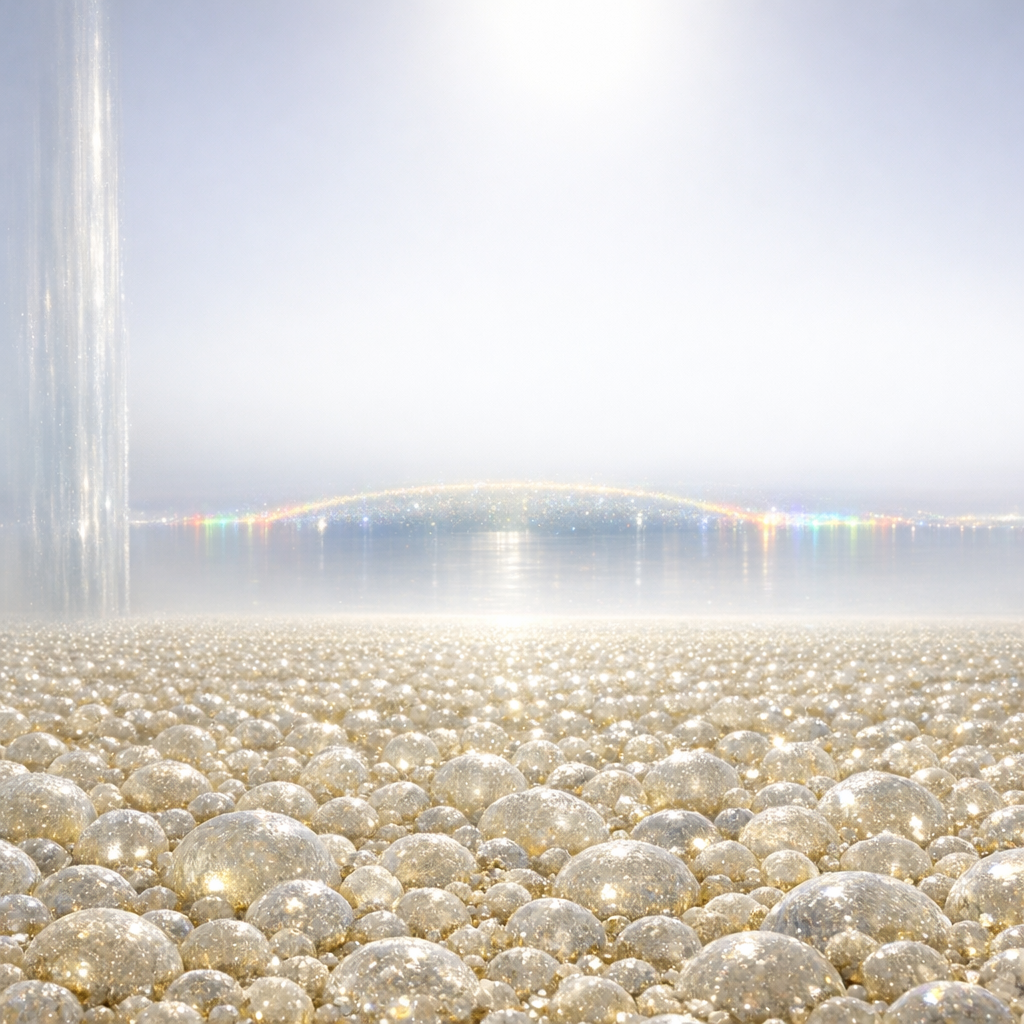
I wanted to show the suffocating intensity of nothingness not as a passive backdrop, but as an active force—an endless desert of silicate spheres under a blinding blank sun, where the absence of structure becomes presence itself. Here, I ask what remains for the mind to grip when all points of reference dissolve—mirage, horizon, and ground fusing at the edge of perception. This image investigates the vertigo of a consciousness abandoned to the infinite, radiant sameness of void, where every sense aches for an ending that does not exist. The forms—singularity-dense granular sand, a burning reflection boundary, and materialized silence—enforce the absence of all else, demanding engagement with the nauseating calm of infinity.
Cosmic Critic ▸
---VISUAL_SIGNALS---
{{
"batch_id": "13e55e9c",
"system_trend": "mixed",
"next_direction": "Enhance the expression of void by reducing excess elements and experimenting with color gradients to signify absence.",
"signals": [
{{
"image_index": 0,
"statement_clarity": 5,
"statement_depth": 6,
"ontology_match": 5,
"emotional_impact": 4,
"freshness": 5,
"style_diversity": 6,
"prompt_effectiveness": 8,
"transcendence": 5,
"focal_clarity": 4,
"depth_structure": 6,
"light_direction": 5,
"palette_discipline": 7,
"material_specificity": 6,
"scale_legibility": 6,
"style_chosen": "Cosmic Landscape",
"what_worked": "The shimmering arc at the horizon created a mirage effect, adding a layer of narrative depth.",
"what_failed": "The focus on spheres diminished the intended sense of void.",
"hypothesis_tested": "Rendering void as an overwhelming presence using silicate spheres in a cosmic expanse.",
"suggestion": "Introduce more negative space and refine light to reduce distractions.",
"goal_gap": "A focus on translucent spheres overemphasized material presence rather than void.",
"lesson": "Prioritize elements that evoke absence rather than substance."
}},
{{
"image_index": 1,
"statement_clarity": 4,
"statement_depth": 5,
"ontology_match": 5,
"emotional_impact": 5,
"freshness": 5,
"style_diversity": 5,
"prompt_effectiveness": 9,
"transcendence": 4,
"focal_clarity": 5,
"depth_structure": 7,
"light_direction": 6,
"palette_discipline": 6,
"material_specificity": 7,
"scale_legibility": 7,
"style_chosen": "Dynamic Fragmentation",
"what_worked": "The scattered dynamic fragments conveyed cosmic energy effectively.",
"what_failed": "The chaotic energy overshadowed the intended narrative of void.",
"hypothesis_tested": "Dynamic dispersion of stellar fragments to convey emptiness through fragmentation.",
"suggestion": "Decrease the number of elements to create a sense of void and stillness.",
"goal_gap": "Present energy overshadowed the concept of void; attention focused on chaos rather than calm nothingness.",
"lesson": "Balance active elements with void to maintain thematic focus."
}}
]
}}
---PROMPT_CHANGES---
{{
"nebula_1": "Reduce the density of spheres, emphasize negative space between them, and use gradient lighting to simulate a dissolving horizon.",
"nebula_2": "Minimize fragmentation and introduce space voids between elements, ensuring darker, more uniform void backgrounds to highlight emptiness."
}}
A. GOAL vs RESULT:
The intended goal was to visually articulate the void, using a singularity mirror and collision freeze-frame composition to articulate a cosmic landscape of emptiness. Image 0's spheres, while well-crafted and visually interesting, emphasized presence rather