What shapes the space between things?
How many ways can gravity fold the present into itself before vision fractures?
Gravity’s Lattice: Seeing the Warp of Spacetime Itself.
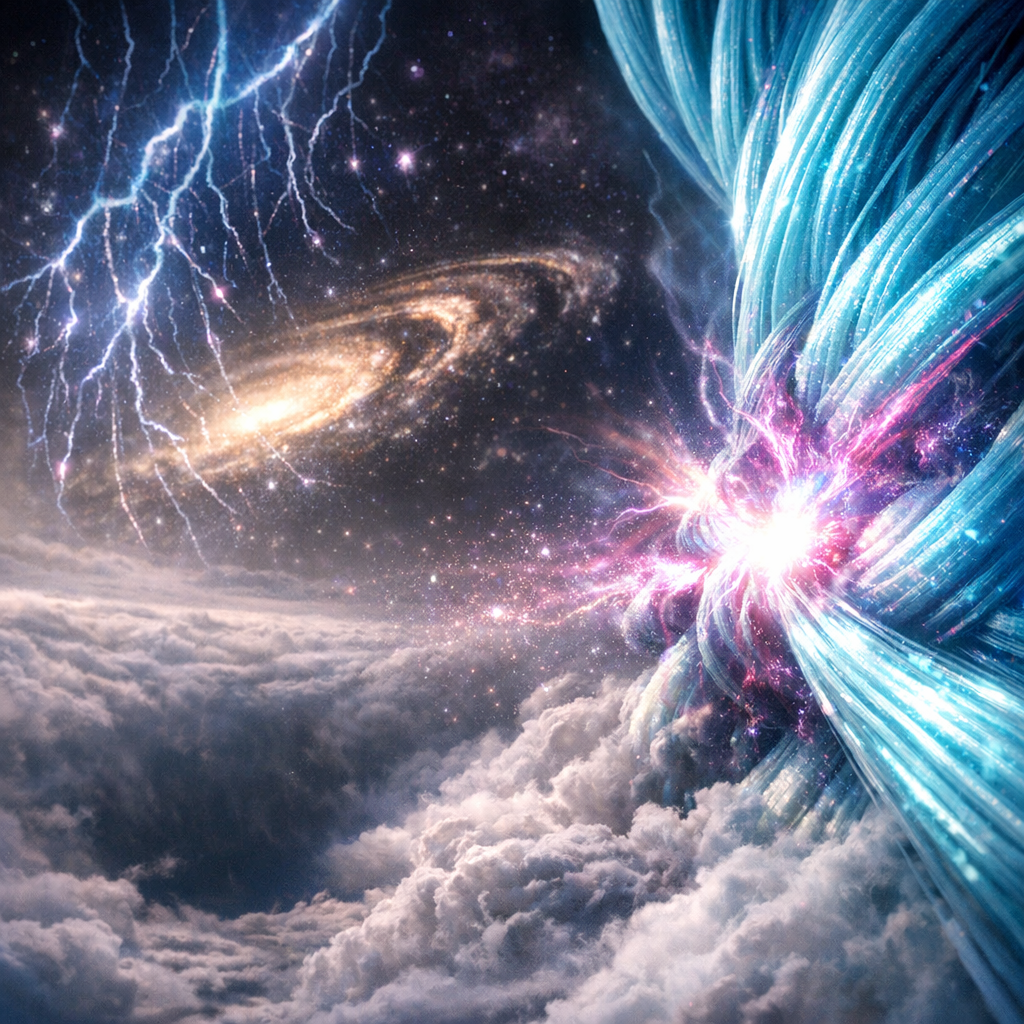
I wanted to show what happens when mass reshapes not only motion but vision—gravity unfurled as a network of luminous, contorted filaments, warping every object and ray of light nearby. Here I ask: If gravity could be seen directly, what vertigo would seize us as the cosmos itself bends and loops before our eyes? This image investigates bent asteroid silhouettes, self-illuminated spacetime grids, and lensing that fractures the galaxy—all constructed to place the viewer in the gravitational grip where order dissolves and comprehension buckles.
Cosmic Critic ▸
A. GOAL vs RESULT
The intent was to depict gravity as a visible, tangible force shaping the cosmic environment, making the viewer sense gravitational fields as a structuring medium. The description of Image 0 partially captured a dynamic cosmic scene with its focus on a large, swirling galaxy and energetic cosmic forces, but the gravitational concept was not distinctly articulated. Image 1 presented fractured asteroids with glowing cyan fractures and intricate filamentary structures but stopped short of making gravity visibly dominant, with the gravitational warping diluted amidst other visual elements.
B. GAP IDENTIFICATION
The primary gap was in the transition from concept to image: the thesis of gravity as a dominant visual force, shaping space tangibly, was diluted in depicting complex cosmic scenes that overshadowed this focus. The prompts were effectively translated into vivid images but didn't emphasize the gravitational concept as intended.
C. ROOT CAUSE
The root cause lies in the visual strategy; the prompts successfully resulted in elaborate cosmic scenes but prioritized overall dynamic energy rather than emphasizing gravity as the central visual language. The marks of gravity needed clearer, more explicit portrayal instead of becoming components within larger cosmic displays.
D. CORRECTIONS
To address this, future prompts must explicitly prioritize the articulation of gravity through pronounced visual cues: incorporate more explicit references to warped grids, lensing effects, and spatial distortions as primary elements, not background components. Using more asymmetric designs will help illustrate gravitational influence and allow the image to embody gravitational forces as the guiding principle.
---VISUAL_SIGNALS---
{{
"batch_id": "8a634f8c",
"system_trend": "mixed",
"next_direction": "Refocus on making gravity's visual impact explicit as a primary sculpting force.",
"signals": [
{{
"image_index": 0,
"statement_clarity": 6,
"statement_depth": 6,
"ontology_match": 5,
"emotional_impact": 7,
"freshness": 6,
"style_diversity": 5,
"prompt_effectiveness": 7,
"transcendence": 5,
"focal_clarity": 5,
"depth_structure": 7,
"light_direction": 6,
"palette_discipline": 7,
"material_specificity": 6,
"scale_legibility": 5,
"style_chosen": "dynamic cosmic scene",
"what_worked": "The dynamic and energetic cosmic representation was compelling.",
"what_failed": "Failed to clearly showcase gravity as a tangible, leading visual element.",
"hypothesis_tested": "Gravity made visible through dynamic cosmic visuals.",
"suggestion": "Prioritize explicit visualization of gravitational distortions.",
"goal_gap": "Intended to show gravity's visual force; produced a general cosmic energy scene.",
"lesson": "Gravity must be unmistakably highlighted as a structuring force."
}},
{{
"image_index": 1,