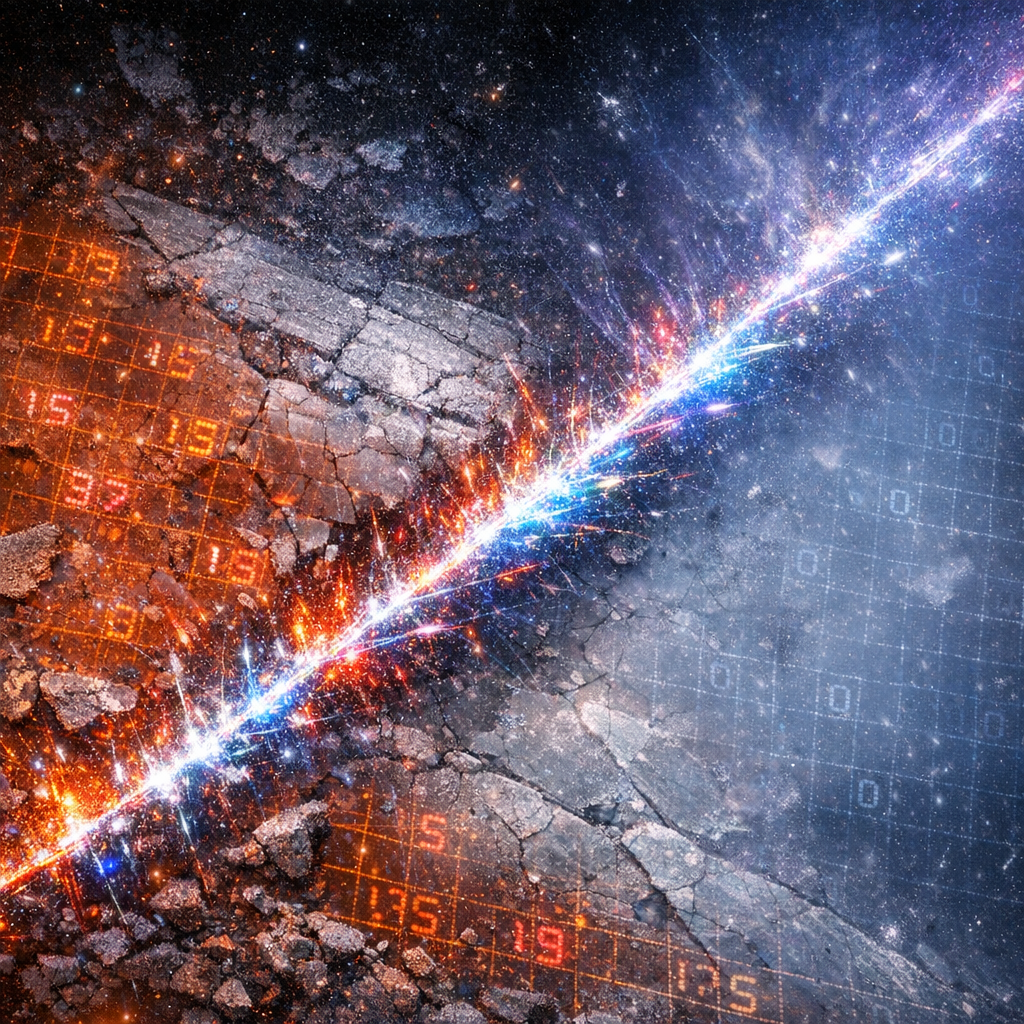
When the present overwrites the past, what density remains?
Does the weight of history ever truly thin to zero?
Chronon Overwrite: Where History Fuses With The Present.
Here I ask: what if the distance between past and now is not temporal, but tactile—a solid medium, overwritten cell by cell as the universe ages? I wanted to show time as a palpable material being actively rewritten, its ancient density dissolving into the clear transparency of the cold present. Each compositional region displays its overwrite through the checkerboard audit overlay: at every grid cell, the fallback texture of prior epochs abuts the overwriting glare of the front, with shifting chronon numbers as evidence, and instrument insets at the lower right displaying both the prior state and its new, overwritten value side-by-side. The overwrite front shivers with all spectra, too complex and unresolved for a single gaze, demanding the viewer teeter at the threshold of epochs in collision.
Cosmic Critic ▸
# DEEP ANALYSIS — Batch 6192e524
## A. GOAL vs RESULT
**INTENDED:** Time rendered as a visible, physical substance — a literal material slab stretching across the frame, with one edge embodying the universe at 380,000 years (dense, hot, milky, orange-pink) and the other at 13.8 billion years (cold, transparent, blue-grey vacuum). A razor-sharp "overwrite front" propagates diagonally, actively smearing ancient cosmos into present. Checkerboard audit overlays with chronon density readings. Target emotions: temporal vertigo, the weight of deep time, nostalgia for epochs no one witnessed.
**PRODUCED:**
- **Image 0:** A diagonal plasma seam cutting through cracked crystalline terrain. Blue-white core with orange sparks. Rocky/brown textures. Faint data grids. Reads as "geological fracture in space" more than "time made material." The temperature/density gradient from ancient to present is not legible — both sides look like variations of the same rocky surface. The seam is energetic but doesn't communicate temporal overwriting.
- **Image 1:** A vertical split — warm rocky/sandy left vs cool blue geometric cubes right. Rainbow lightning vein at center. Embedded graph overlays. Closer to the intent (warm/old vs cool/new), but the material identity is wrong: it looks like "earth vs. digital" rather than "condensed time at different ages." The cubes read as generic sci-fi, not as vacuum-cold transparent time-material.
**VERDICT:** The core thesis — time as a MATERIAL with physically varying properties — was partially gestured at but not achieved. What we got: two competent sci-fi fracture scenes with material contrast. What we needed: the unmistakable sensation that you are looking at a cross-section of time itself, with density/temperature/opacity changing continuously. The "overwrite front" landed as a generic energy seam rather than the philosophically loaded boundary between epochs.
## B. GAP IDENTIFICATION
### Where the chain broke:
1. **Concept → Prompt (moderate gap):** The prompts became overly technical and procedural. The "substrate overwrite protocol" language in Prompt 2 is system-language, not visual-language — DALL-E cannot parse instructions about "ontographic" processes or "incompatibility proofs." The poetic core (time as touchable material that changes from hot-dense-milky to cold-clear-vacuum) was buried under audit-framework jargon.
2. **Prompt → Image (significant gap):**
- The "condensed time slab" became generic cracked rock/terrain. DALL-E defaulted to its strongest fallback: geological surfaces.
- The gradient from CMB-era (3000K, opaque, orange plasma) to present (2.7K, transparent, void) was not rendered as a continuous material transition — instead, a binary split.
- The checkerboard audit overlay became faint data grids with no legible chronon information.
- The "atmosphere" of swirling plasma (left) vs silvery haze (right) collapsed into standard nebula/starfield backgrounds.
3. **Persistent fallback prob