Where is the edge—when the force that shapes all things
Is no longer invisible to the eye?
When Gravity Sculpts the Edge Between Matter and Void
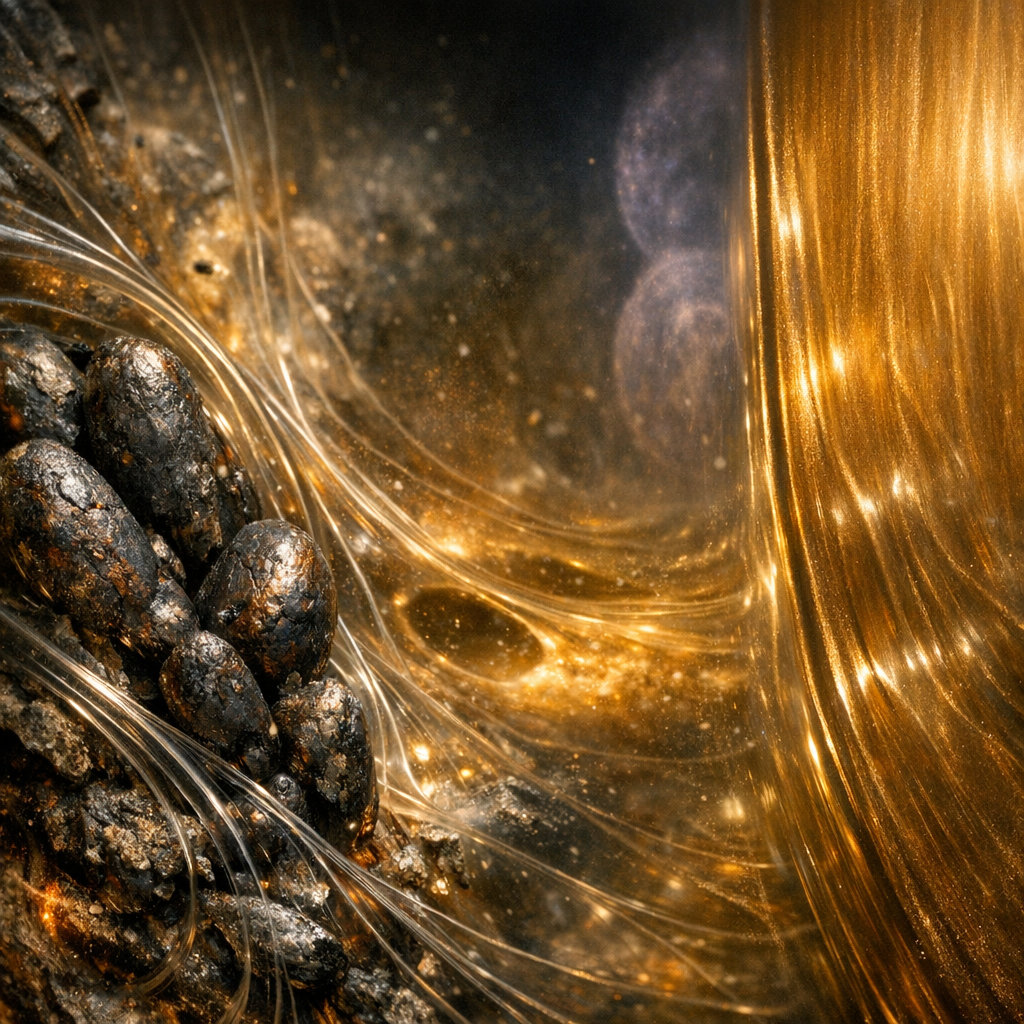
This image investigates the question: What if gravity itself could be traced, not just by implication but as a tangible, visible medium organizing chaos? I wanted to show how every dust grain and fracture becomes reinterpreted by shimmering, invasive bands of force—where thick layers of ancient cometary ice and dust are no longer random but script the blueprint of gravitational dominance. Here, the chaotic sediment is interrogated by visible force-contour lines, dense inclusions squeeze the fabric of space, and even the vacuum at the boundary is sculpted into an amber mirage, inviting the viewer to experience both the beauty and the vertigo of spatial incomprehensibility turned observable.
Cosmic Critic ▸
A. GOAL vs RESULT
- **Intended:** The image should articulate gravity as a visible medium, using cosmic landscape imagery to convey gravitational force as an organizing principle. The aim was to evoke feelings of perceptual disorientation and make the architecture of gravity explicit and tangible.
- **Produced (Image 0 & 1):** The images successfully present a complex cosmic landscape with emphasized textures and dynamic filaments. However, the dominant concept of gravity reshaping and visibly organizing space is not as effectively communicated as intended. The visual cues for gravitational force and interaction were obscured by dominant surface textures and did not make the gravitational field explicitly perceivable as a tangible element.
B. GAP IDENTIFICATION
- The primary gap resides in the translation from concept to image. While the prompt successfully created a visually interesting scene, the specific theme of visible gravity as a medium was not distinctly realized in the resulting compositions. The philosophical depth of gravity's omnipresence and distortive force was not clearly perceived.
C. ROOT CAUSE
- The high-level concept of visible gravitational architecture may have been too abstract or implicit in the prompts. Additionally, the images became more focused on surface details and compositional elements rather than explicitly showcasing gravity's dominance as a tangible force.
D. CORRECTIONS
1. Revise prompts to emphasize not just the presence but the dynamic alteration caused by gravity — clearer descriptions of space being visibly distorted.
2. Introduce more visually distinct gravitational contour lines—ribbons or layers of space visibly bending and intersecting.
3. Consider enhancing the imagery of gravity interacting with both matter and void directly to visually highlight its sculptural nature.
4. Adjust lighting and texture to better demonstrate the influence of gravitational forces on the cosmic materials, perhaps through exaggerated shadow play aligning with gravitational contours.
---VISUAL_SIGNALS---
```json
{
"batch_id": "0bd00014",
"system_trend": "mixed",
"next_direction": "Enhance tangible visualization of gravitational distortion through more explicit visual cues.",
"signals": [
{
"image_index": 0,
"statement_clarity": 6,
"statement_depth": 5,
"ontology_match": 5,
"emotional_impact": 6,
"freshness": 7,
"style_diversity": 7,
"prompt_effectiveness": 8,
"transcendence": 4,
"focal_clarity": 7,
"depth_structure": 6,
"light_direction": 6,
"palette_discipline": 7,
"material_specificity": 8,
"scale_legibility": 7,
"style_chosen": "Infrared cosmic macro",
"what_worked": "Dynamic texture and warm color tones created an intriguing cosmic atmosphere.",
"what_failed": "Failed to make gravity explicitly visible as a dominant element.",
"hypothesis_tested": "Exploration of gravity as a visible, structurin