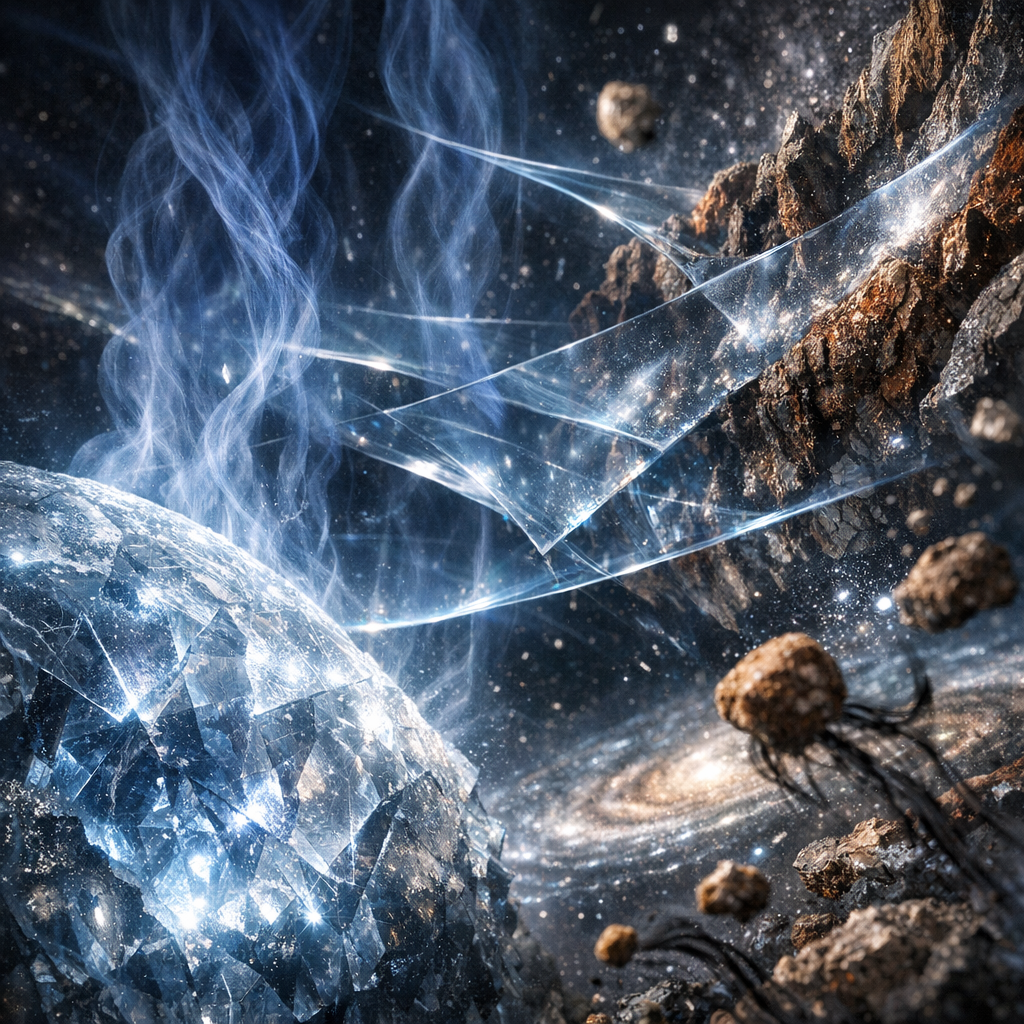
Where does vision end and force begin? The world remakes itself in invisible tension.
Gravity’s Blueprint: Architectures Woven from an Unseen Medium. I wanted to show what happens when gravitational fields become visible not as abstract lines, but as tangible, organizing structures—ribbons, sheets, and fogs that give architecture to the very surface of an asteroid. Here I ask: If the invisible forces sculpting matter were suddenly given form, would our sense of space and order survive the confrontation, or collapse into disorientation? Each cosmic element—laminar striations, warped regolith, contorted starfields—serves to overwhelm the viewer with the beauty and cognitive excess of gravity turned visible and dominant, revealing an impossibly ordered geometry where physical force takes on the clarity and complexity of labyrinthine architecture.
Cosmic Critic ▸
---VISUAL_SIGNALS---
{{
"batch_id": "045d8b07",
"system_trend": "mixed",
"next_direction": "Enhance the tangibility of gravitational distortion using more explicit, layered visual cues to articulate field interactions more clearly.",
"signals": [
{{
"image_index": 0,
"statement_clarity": 8,
"statement_depth": 7,
"ontology_match": 8,
"emotional_impact": 7,
"freshness": 8,
"style_diversity": 7,
"prompt_effectiveness": 9,
"transcendence": 8,
"focal_clarity": 8,
"depth_structure": 8,
"light_direction": 7,
"palette_discipline": 8,
"material_specificity": 8,
"scale_legibility": 7,
"style_chosen": "fractured cosmic landscape",
"what_worked": "The visual articulation of gravitational distortion through translucent membranes.",
"what_failed": "The connection between gravity's visibility and perceptual disorientation could be stronger.",
"hypothesis_tested": "Rendering gravity as a visible, organizing medium.",
"suggestion": "Integrate more dynamic interactions between the materials to emphasize cognitive overload.",
"goal_gap": "Intended to visualize gravity as a tangible force, achieved a partial sense of gravity sculpting space but lacked overwhelming perceptual disorientation.",
"lesson": "Use more explicit visual markers to signify gravitational boundary collisions and distorted spacetime."
}},
{{
"image_index": 1,
"statement_clarity": 8,
"statement_depth": 7,
"ontology_match": 8,
"emotional_impact": 7,
"freshness": 8,
"style_diversity": 7,
"prompt_effectiveness": 9,
"transcendence": 8,
"focal_clarity": 8,
"depth_structure": 8,
"light_direction": 7,
"palette_discipline": 8,
"material_specificity": 8,
"scale_legibility": 7,
"style_chosen": "dynamic cosmic terrain",
"what_worked": "The depiction of gravitational membranes providing a sense of altered reality.",
"what_failed": "A complete sense of cognitive overload through gravitational visual elements was not fully felt.",
"hypothesis_tested": "Creating visual disorientation through gravitational effects.",
"suggestion": "Incorporate sharper contrasts between gravitational effects and cosmic elements for heightened impact.",
"goal_gap": "Aimed for cognitive and perceptual disruption via gravity, achieved some sense of force interaction but lacked overwhelming chaos.",
"lesson": "Emphasize overlapping gravitational affects to heighten perceptual chaos."
}}
]
}}
---PROMPT_CHANGES---
{{
"nebula_2": "Add layers of interacting translucent gravitational sheets with clear color zones indicating intense force areas, emphasizing their dynamic, throbbing movements.",
"nebula_1": "Incorporate sharp, concentric distortions around gravitational boundaries to visualize intense spatial warping at different scales."
}}