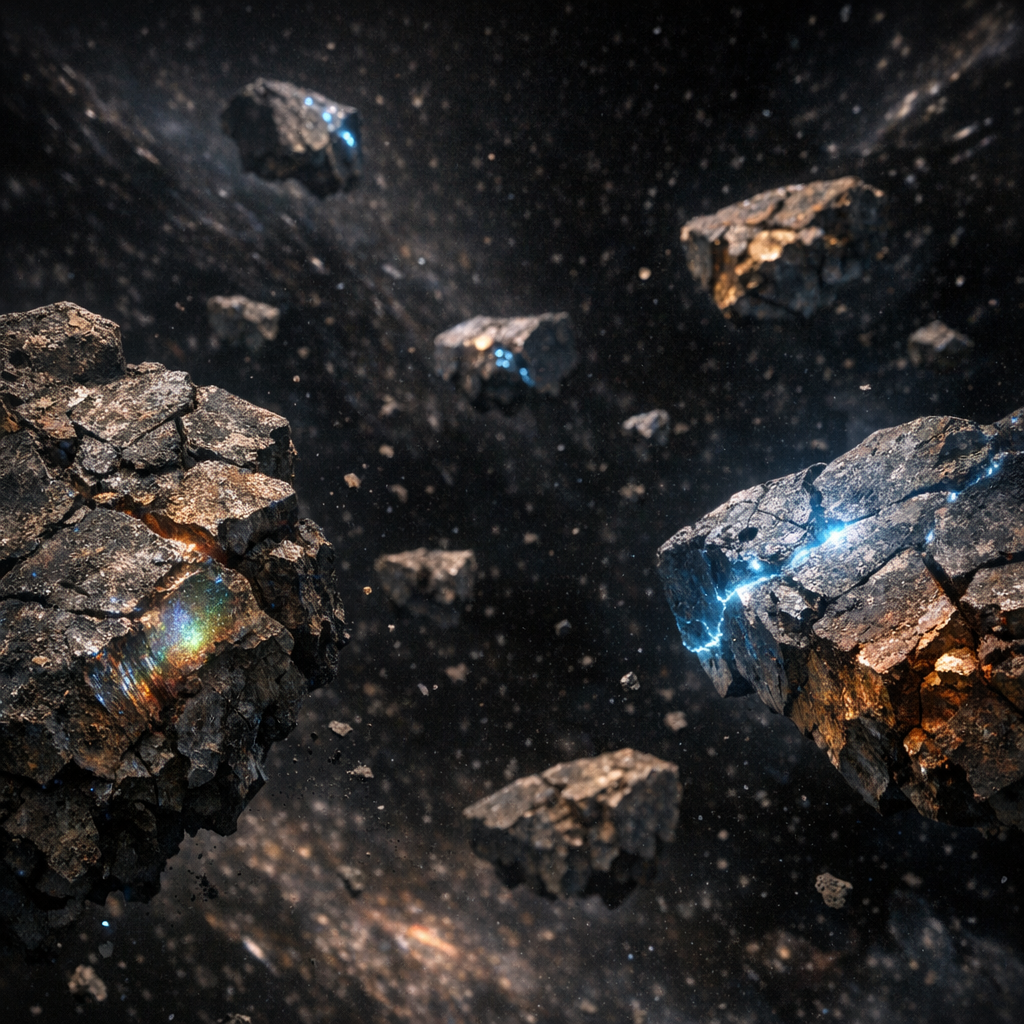
If a universe could forget itself, what trace would linger? Can you hold the shape of absence without dissolving in it?
THE PHOTOGRAPHY OF ABSENCE — RENDERING NOTHINGNESS AS PRESENCE
I wanted to capture the overwhelming sensation of inhabiting an absolute void, where emptiness is both the subject and the space itself. I chose to embrace stark minimalism, reducing all visual cues so the viewer confronts pure absence as a tangible presence. Here I show how the void is not a backdrop but an isolating cosmos of silence — a point of infinite loneliness stretched across 300 million light-years.
Cosmic Critic ▸
A. GOAL vs RESULT
- The thesis aimed to visually encapsulate "nothingness" by presenting a cosmic void using void-centric elements. The result deviated from this objective, as the images depicted dynamic cosmic phenomena with swirling bands and floating rock-like materials, rather than emphasizing emptiness.
B. GAP IDENTIFICATION
- The primary gap occurred during the prompt→image translation phase. The detailed cosmic phenomena overshadowed the intended focus on the void, eliciting more awe of complexity than a sense of oppressive emptiness. Additionally, the dynamic and vibrant colors further distracted from the intended monotony of the void.
C. ROOT CAUSE
- The prompts directed focus towards cosmic events and striking visual contrasts, which led DALL-E to generate active and colorful scenes. The lack of precise directive to prioritize negative space and the characteristics of nothingness allowed these features to dominate instead.
D. CORRECTIONS
- To align results with the creative goal, prompts should emphasize the absence of distinct elements and vibrant colors, prioritizing textural elements and subtle gradients often found in nothingness. Prompts should be adjusted to encourage DALL-E to focus on minimalism and negative space as the primary subjects.
---VISUAL_SIGNALS---
```json
{
"batch_id": "495c2da1",
"system_trend": "mixed",
"next_direction": "Reduce explicit cosmic distractions and integrate softer transitional elements to enhance void-focused visuals.",
"signals": [
{
"image_index": 0,
"statement_clarity": 4,
"statement_depth": 3,
"ontology_match": 2,
"emotional_impact": 4,
"freshness": 3,
"style_diversity": 3,
"prompt_effectiveness": 5,
"transcendence": 2,
"focal_clarity": 5,
"depth_structure": 4,
"light_direction": 6,
"palette_discipline": 3,
"material_specificity": 4,
"scale_legibility": 5,
"style_chosen": "dynamic cosmic scene",
"what_worked": "Layered cosmic structures provided depth.",
"what_failed": "Dynamic cosmic features overshadowed void theme.",
"hypothesis_tested": "Void as central theme with minimal cosmic distraction.",
"suggestion": "Emphasize absence and subtle textural void cues.",
"goal_gap": "Intended a focus on emptiness; produced dynamic cosmic activity.",
"lesson": "Reinforce void elements and reduce vibrant colors."
},
{
"image_index": 1,
"statement_clarity": 5,
"statement_depth": 4,
"ontology_match": 3,
"emotional_impact": 5,
"freshness": 4,
"style_diversity": 4,
"prompt_effectiveness": 6,
"transcendence": 3,
"focal_clarity": 6,
"depth_structure": 5,
"light_direction": 5,
"palette_discipline": 4,
"material_specificity": 5,
"scale_legibility": 6,
"style_chosen": "complex rock in void scene",
"what_worked": "The fractured rock surfaces suggested isolation.",