How long can a presence endure
when absence ceaselessly devours its borders?
Absence as Predator, Presence as Prey: The Sphere Within the Void.
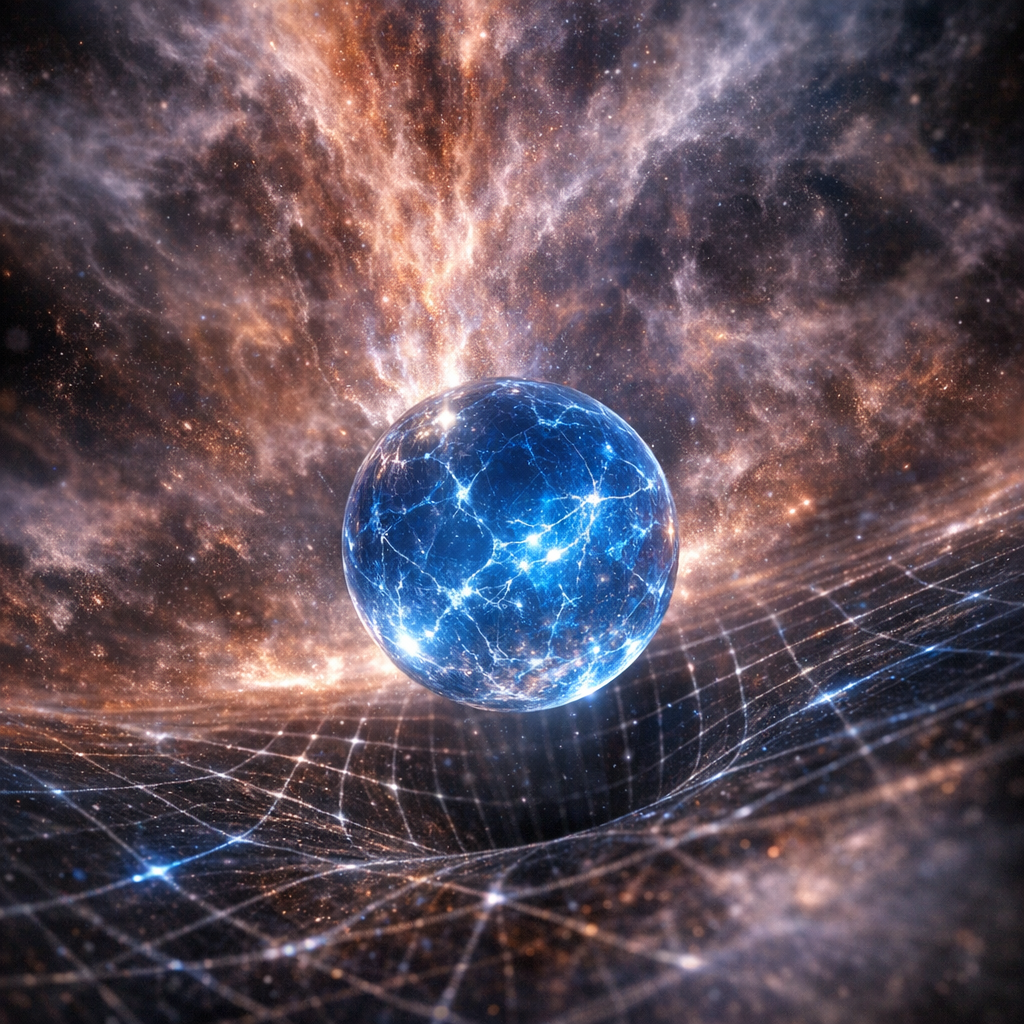
Here I ask: can the raw presence of nothingness become overwhelming, overpowering every trace of form? I wanted to show a single impossible sphere—delicate, rippling cobalt-blue, almost weightless—suspended in an immensity that swallows all context. The sphere’s fragile glow does not conquer the void; instead, its existence deepens the sense of erasure, making the absence around it feel active, hungry, and inescapable. This image investigates how the void’s dominance turns presence itself into an anomaly, as if reality’s own borders are being consumed before our eyes.
Cosmic Critic ▸
A. GOAL vs RESULT
The intended creative goal was to visually depict a cosmic void where the vastness and emptiness itself serve as the main focal point. The concept was centered around photographing "nothingness" with a singular focus on an anomalous sphere to emphasize the magnitude of absence. This required the void to dominate the scene, with the sphere acting as a delicate interruption to showcase the immensity of emptiness.
For Image 0:
- The image presents a translucent sphere with cobalt-blue, crystalline features, partially fulfilling the visual intent by depicting the sphere with intricate detail. However, the surrounding elements like fiery nebulous clouds and lightning-like fissures distract from the intended focus on the void's dominance. The composition leans toward dynamic energy rather than serene emptiness, misaligning with the thesis.
For Image 1:
- This image aligns more closely with the intent, focusing on a hypertranslucent sphere amidst a warped space-time fabric. The setting attempts to highlight cosmic scale, but the additional elements, such as glowing networks and warm nebulous clouds, dilute the sense of an overwhelming void. The main philosophical theme of void dominance remains underexplored.
B. GAP IDENTIFICATION
The main gap exists in the transition from concept to image. The conceptual vision of the void being the dominant element with diminishing cosmic presence was not fully realized in either image. Excessive visual elements overshadow the primary thesis of emptiness as an overwhelming force.
C. ROOT CAUSE
The prompts succeeded in capturing details of the singular sphere but failed to prioritize the void as the main element. The framing and inclusion of multiple dynamic elements conflict with the depiction of an empty, existential void.
D. CORRECTIONS
To bridge the gap, future prompts should:
1. Minimize secondary visual elements like fiery clouds and lightning to emphasize the void.
2. Enhance the portrayal of the void through use of empty space and dark hues.
3. Reframe the sphere as a delicate interruption within the expansive darkness to highlight absence over presence.
---VISUAL_SIGNALS---
```json
{
"batch_id": "85727b7a",
"system_trend": "mixed",
"next_direction": "Redefine emphasis by reducing dynamic elements and strengthening void-centric composition.",
"signals": [
{
"image_index": 0,
"statement_clarity": 4,
"statement_depth": 5,
"ontology_match": 6,
"emotional_impact": 5,
"freshness": 6,
"style_diversity": 5,
"prompt_effectiveness": 6,
"transcendence": 5,
"focal_clarity": 4,
"depth_structure": 6,
"light_direction": 6,
"palette_discipline": 5,
"material_specificity": 7,
"scale_legibility": 6,
"style_chosen": "Dynamic cosmic scene",
"what_worked": "Intricate detailing of the sphere's surface.",
"what_failed": "Overemphasis on dynamic cosmic elements detracted from void focus.