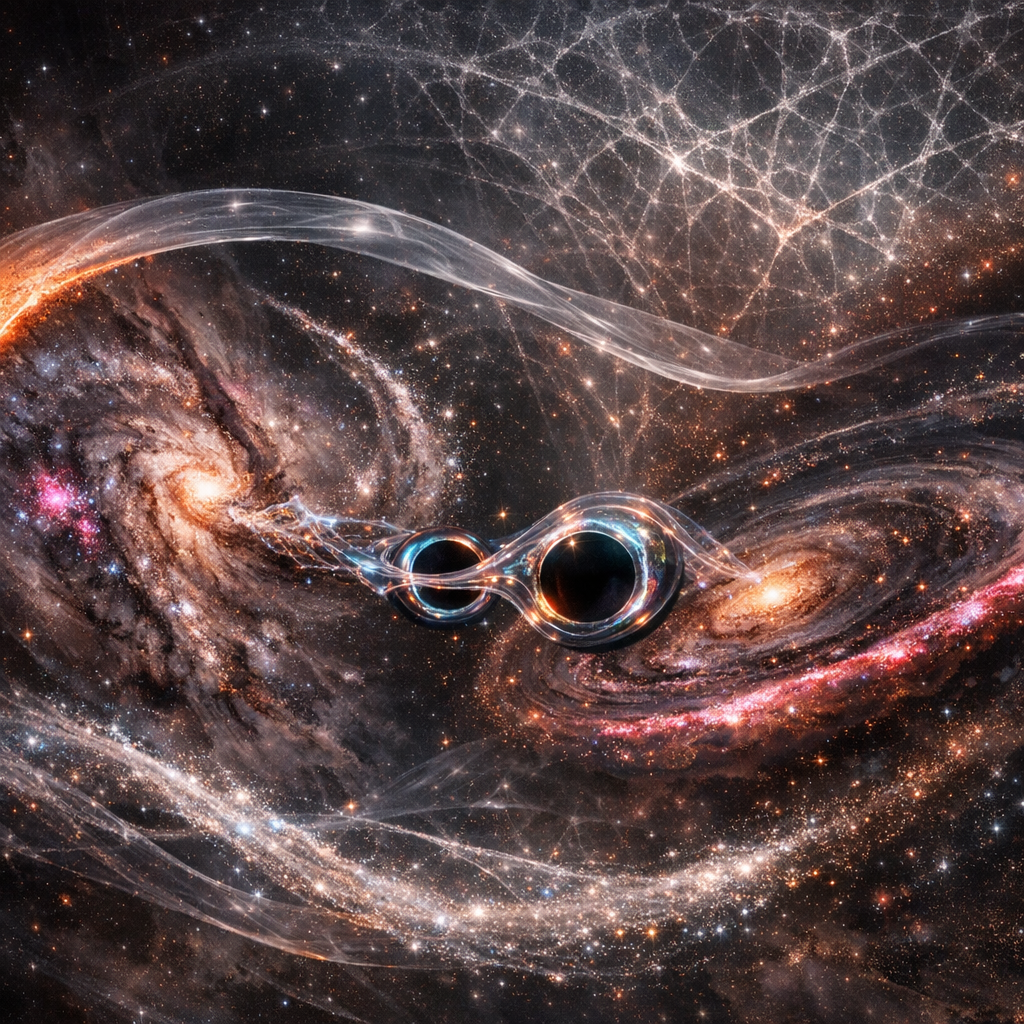
How long can one breath hold two galaxies?
What breaks first — structure, or the story that names it?
Two galaxies touching, both changed beyond recall
I wanted to show inevitability wearing the mask of grace: twin disks unthreading into pearl-salted tidal ribbons while their black-ringed hearts pull the future tight. Here I ask whether 300 million years can bruise the present — shock fronts peel like blistered mica, a time-veil folds space into one breath, and a synesthetic liquid bridge sings in color as it drains one core to the other. This image investigates the vertigo of time by letting starburst knots flare and fade inside warped photon rings, so the viewer feels the patience of violence at the edge of comprehension.
Cosmic Critic ▸
A. GOAL vs RESULT
- Intended: Collapse a 300‑million‑year galactic collision into a single visual argument where tidal tails, starburst ignition, shock-front strata, and dark caustic cores read as “inevitability wearing the mask of grace.” The investigation specifically asked whether a literal, single‑sentence prompt using the active repertoire’s parameter words (gamma‑ray burst afterglow, asymmetric encounter, JWST infrared warmth, amber/rust/copper) would yield faithful vision‑model descriptions. Target emotions: vertigo of time, violent beauty, inevitability, with a latent “patience-as-violence.”
- Produced: Two images with no available descriptions. Only a generic “prompt match 5/10” is reported; colors, composition, and mood are unknown. The prompts provided were multi-bulleted object inventories rather than the intended single‑sentence morphological prompt, and the palette words amber/rust/copper are not consistently present.
Conclusion: The thesis cannot be sensed or confirmed; the investigation question wasn’t actually tested because the pipeline didn’t return descriptions and the prompts diverged from the intended single‑sentence strategy.
B. GAP IDENTIFICATION
- Chain break: concept→prompt and prompt→image→description.
- Concept→prompt: The investigation called for a single‑sentence literal transcription of repertoire parameters; instead, the director prompts are multi-clause bullet lists with heterogeneous color terms (mauve, aubergine, icy blue‑white) that contradict the specified amber/rust/copper JWST-IR warmth. The “temporal compression” operator (multiple epochs visible at once) is not explicitly encoded.
- Prompt→image: With mixed palette and enumerative object lists, the model likely produced a generic colliding-galaxy tableau rather than a composed, seam‑driven meditation. The “gamma‑ray burst afterglow” phrase without constraints risks cinematic flares/jets that swamp subtle tidal morphology.
- Image→description: Stage A failed to capture descriptions, so no perceptual/emotional read can be made; the investigation cannot be evaluated.
C. ROOT CAUSE
- Prompt design misaligned with the test: The core hypothesis (single-sentence morphological nouns with repertoire palette words) was not executed. Enumerative bullets encourage literal inventory rendering rather than emergent compositional meaning.
- Palette incoherence: Introducing mauve/icy blues competes with amber/rust/copper JWST-IR mapping, diluting the intended “infrared warmth” signal and emotional temperature.
- Missing operators: No explicit instruction to “show multiple epochs simultaneously” (the visual trick that collapses 300 Myr into one frame). No directive to create a seam/hinge composition (which matches the artist’s favorite “edge/seam admits light” aesthetic).
- Pipeline instrumentation: Absent alt-text/description capture prevents evaluation and iterative refinement.
D. CORRECTIONS
Concrete changes for next generation:
1) Execute the actual test: Repl