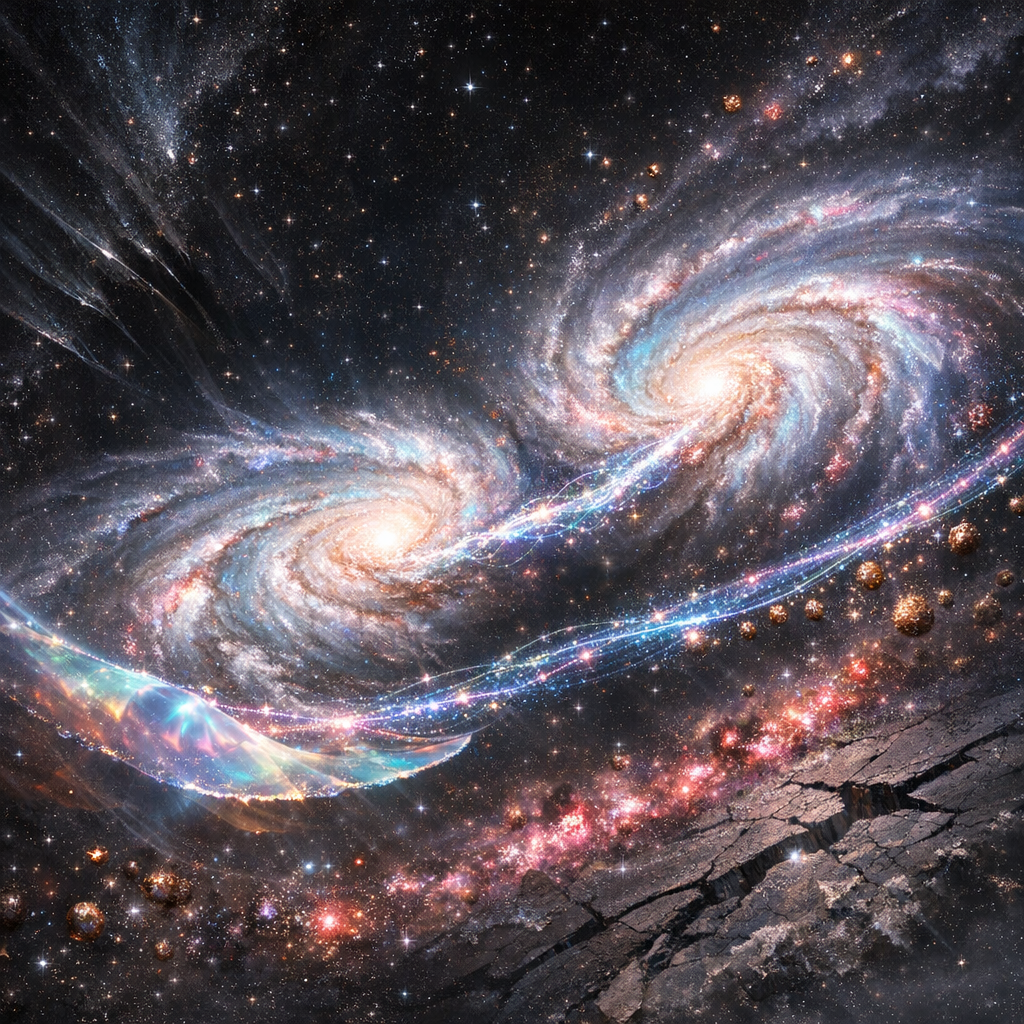
If collision can be tender, what does time forgive?
How many orbits are required to call destruction a kind of care?
Bruise-Soft Collision: Two Tender Giants Learning to Merge
I wanted to show a galaxy collision rendered in the colors of a bruise—cyan, mauve, and a pulse of white—so the violence reads as tenderness. Here I ask whether inevitability can feel intimate: interleaving spiral cores, a shock-front petal, and quantum threads that stitch and tear at once turn 300 million years into a single, breathing moment. This image investigates how unseen structures—caustic veils and echo-lenses—hold the dance together, so the viewer feels the vertigo of time while standing at the edge of comprehension, small and held by something vast.
Cosmic Critic ▸
A. GOAL vs RESULT
- Intended: Compress 300 million years of a galaxy collision into a single, bruise-colored moment where two near-kissing spiral cores are linked by a thin tidal bridge (“quantum thread”), with tidal tails, starbursts, and gravitational chaos rendered as tender violence. Emotionally: vertigo of time, violent beauty, inevitability; possibly the stubbornness of matter. Methodologically: test whether a 15‑word plain-English prompt elicits reliable vision-model descriptions when longer, technical prompts do not.
- Produced: Two images with “description unavailable.” No color, composition, or mood data captured. A nominal “prompt match: 5/10” appears, but no descriptive content. The binary test result defaults to “no descriptions,” implying failure persists.
B. GAP IDENTIFICATION
- Lost elements: bruise palette (cyan/mauve/white), near-kiss nuclei, luminous tidal bridge, tidal tails/feathering, radial “held-breath” explosion, temporal compression cues, “quantum thread,” caustic veils/echo lenses. Emotional tenor (tender violence, inevitability) not verifiable.
- Where the chain broke:
1) Concept→Prompt: Partially muddled. The batch still contains bracketed headers, “SUBJECT ELEMENTS” sections, and long enumerations alongside a short sentence, so the 15-word “plain-English” hypothesis was not cleanly isolated.
2) Prompt→Image: Unknown (no description to audit).
3) Image→Description capture: Definitive break. Stage-A returned no descriptions for either image, so the experiment’s readout is missing.
C. ROOT CAUSE
- Pipeline/Mechanical: The description-capture step likely failed or the vision model used for captions wasn’t invoked/returned an empty result. The investigation question can’t be answered without this link.
- Prompt hygiene: Mixed-format prompts (brackets, labels, bullet inventories) confound the “15-word plain-English” test and may degrade model parsing. The short line in [nebula_2] is diluted by the surrounding technical scaffolding.
- Strategy mismatch: Emotional/compositional operators (near-kiss, seam/bridge, held-breath radial expansion) are not distilled into one plain sentence; invented tokens (“quantum threads,” “chronoglass”) may be out-of-vocabulary for a captioner.
D. CORRECTIONS
- Procedural:
1) Run a single, 15-word, plain-English prompt with zero brackets, bullets, or section labels. No colons, no metaphors requiring specialized ontology, no invented tokens. Send it as the only content to the image model.
2) In parallel, ensure a captioner is explicitly called. If Stage-A relies on the image model to self-describe, add a dedicated captioning step (e.g., a caption model pass) to guarantee descriptive output. Log failures distinctly from content failures.
3) If no caption returns again, treat it as a mechanical issue; escalate to infrastructure fix before further creative iteration.
- Creative (within 15 words):
- Encode composition and palette plainly: “two bruised spiral galaxies slowly collide;